Klassifizierung / Names
Namen | Synonyme | Catalog of Fishes(Gattung, Arten) | ITIS | CoL | WoRMS | Cloffa
Holocephali (Chimären, Seekatzen) (chimaeras) >
Chimaeriformes (Chimaeras) >
Callorhinchidae (Plownose chimaeras)
Etymology: Callorhinchus: Tautonymous with Chimaera callorynchus Linnaeus 1758 (but unnecessarily emended from -rynchus to -rhinchus: callum (L.), hard skin; rhynchus (L.), snout, referring to peculiar hoe-shaped proboscis (See ETYFish); callorynchus: callum (L.), hard skin; rhynchus (L.), snout, referring to peculiar hoe-shaped proboscis (See ETYFish).
More on author: Linnaeus.
Umwelt: Milieu / Klimazone / Tiefenbereich / Verbreitungsgebiet
Ökologie
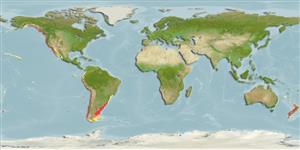
seewasser demersal; tiefenbereich 10 - 116 m (Ref. 34015). Subtropical; 5°C - 10°C (Ref. 34015); 3°S - 56°S, 82°W - 43°W
Southeast Pacific and Southwest Atlantic.
Größe / Gewicht / Alter
Geschlechtsreife: Lm ? range ? - ? cm
Max length : 89.2 cm SL Männchen/unbestimmt; (Ref. ); common length : 70.0 cm TL Männchen/unbestimmt; (Ref. 6077)
Kurzbeschreibung
Bestimmungsschlüssel | Morphologie | Morphometrie
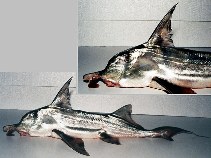
Rückenflossenstacheln (insgesamt) : 1. Pectorals very large (Ref. 27363).
Body shape (shape guide): elongated.
Occurs in sandy and muddy substrates. Apparently associated with Stromateus brasiliensis and Discopyge tschudii (Ref. 34015). Oviparous (Ref. 50449). Max length (Itamar Alves Martins, pers. comm., 2002).
Lebenszyklus und Paarungsverhalten
Geschlechtsreife | Fortpflanzung | Ablaichen | Eier | Fruchtbarkeit | Larven
Menni, R.C., R.A. Ringuelet and R.H. Aramburu, 1984. Peces marinos de la Argentina y Uruguay. Editorial Hemisferio Sur S.A. Buenos, Aires, Argentina. 359 p. (Ref. 2806)
IUCN Rote Liste Status (Ref. 130435: Version 2025-2 (Global))
Bedrohung für Menschen
Harmless
Nutzung durch Menschen
Fischereien: kommerziell
Tools
Zusatzinformationen
Download XML
Internet Quellen
Schätzungen auf der Grundlage von Modellen
Bevorzugte Temperatur (Ref.
123201): 7.5 - 14.8, mean 11.3 °C (based on 125 cells).
Phylogenetischer Diversitätsindex (Ref.
82804): PD
50 = 0.7500 [Uniqueness, from 0.5 = low to 2.0 = high].
Bayesian length-weight: a=0.00457 (0.00219 - 0.00954), b=3.13 (2.94 - 3.32), in cm total length, based on LWR estimates for this species & (Sub)family-body (Ref.
93245).
Trophische Ebene (Ref.
69278): 3.4 ±0.1 se; based on diet studies.
Widerstandsfähigkeit (Ref.
120179): niedrig, Verdopplung der Population dauert 4,5 - 14 Jahre. (Fec assumed to be <100).
Anfälligkeit der Fischerei (Ref.
59153): High to very high vulnerability (65 of 100).
🛈
Nährstoffe (Ref.
124155): Calcium = 36.4 [9.4, 104.6] mg/100g; Iron = 0.898 [0.331, 3.776] mg/100g; Protein = 14 [11, 18] %; Omega3 = 0.238 [0.103, 0.526] g/100g; Selenium = 28.6 [5.8, 75.6] μg/100g; VitaminA = 7.6 [2.6, 20.9] μg/100g; Zinc = 0.617 [0.320, 1.178] mg/100g (wet weight); based on
nutrient studies.