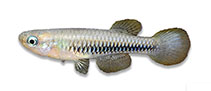
Klassifizierung / Names
Namen | Synonyme | Catalog of Fishes(Gattung, Arten) | ITIS | CoL | WoRMS | Cloffa
>
Cyprinodontiformes (Rivulines, killifishes and live bearers) >
Procatopodidae (African lampeyes) > Procatopodinae
Eponymy: This is a toponym; the holoypes of these fishes were collected in Katanga Province (formerly part of the Belgian Congo, now the Democratic Republic of Congo). (Ref. 128868), visit book page.
More on author: Boulenger.
Taxonomic Remarks
In Micropanchax in CofF (v, April 2020) following Skelton (2019: Ref. 120641). However no evidence is presented in the latter publication. More work is needed.
Umwelt: Milieu / Klimazone / Tiefenbereich / Verbreitungsgebiet
Ökologie
; süßwasser benthopelagisch; pH range: 6.5 - 7.2; standorttreu. Tropical; 20°C - 28°C (Ref. 2060); 11°S - 28°S
Africa: widely distributed in southern Africa (Ref. 47311). Found in rivers and lakes of the southern Democratic Republic of Congo, Angola, Botswana, Zambia, Zimbabwe, Malawi, Mozambique, South Africa and Namibia (Ref. 3788, 47311).
Größe / Gewicht / Alter
Geschlechtsreife: Lm ? range ? - ? cm
Max length : 5.0 cm TL Männchen/unbestimmt; (Ref. 52193)
Rückenflossenstacheln (insgesamt) : 0; Rückenflossenweichstrahlen (insgesamt) : 8 - 10; Afterflossenstacheln: 0; Afterflossenweichstrahlen: 14 - 15.
It is found in schools mainly in the shallow and vegetated part of small rivers, brooks and swamps, and in the shallow parts of lakes (Ref. 47311). Uncommon in floodplains (Ref. 52193). It feeds on insect larvae, daphnia and other small invertebrates (Ref. 52193). Typical serial spawner, laying eggs on vegetation (Ref. 52193). Useful as a mosquito control agent (Ref. 7248). Not a seasonal killifish. Is difficult to maintain in aquarium (Ref. 27139).
Lebenszyklus und Paarungsverhalten
Geschlechtsreife | Fortpflanzung | Ablaichen | Eier | Fruchtbarkeit | Larven
Wildekamp, R.H., 1995. A world of killies. Atlas of the oviparous cyprinodontiform fishes of the world. Volume II. The genera Aplocheilichthys, Aplocheilus, Austrofundulus, Campellolebias, Crenichthys, Cualac, Cubanichthys. Cynolebias, Cynopoecilus and Cyprinodon. The American Killifish Association, Inc. 384 p. (Ref. 47311)
IUCN Rote Liste Status (Ref. 130435: Version 2025-2 (Global))
Bedrohung für Menschen
Harmless
Nutzung durch Menschen
Aquarium: Kommerziell
Tools
Zusatzinformationen
Download XML
Internet Quellen
Schätzungen auf der Grundlage von Modellen
Phylogenetischer Diversitätsindex (Ref.
82804): PD
50 = 0.5000 [Uniqueness, from 0.5 = low to 2.0 = high].
Bayesian length-weight: a=0.00562 (0.00224 - 0.01412), b=3.07 (2.85 - 3.29), in cm total length, based on LWR estimates for this (Sub)family-body shape (Ref.
93245).
Trophische Ebene (Ref.
69278): 3.3 ±0.35 se; based on food items.
Anfälligkeit der Fischerei (Ref.
59153): Low vulnerability (10 of 100).
🛈