>
Cichliformes (Cichlids, convict blennies) >
Cichlidae (Cichlids) > Pseudocrenilabrinae
Etymology: Maylandia: In honour of Hans J. Mayland, German ictiologist (Ref. 45335).
Eponymy: Hans-Joachim Mayland (1928–2004) was a German ichthyologist, aquarist, photographer and writer. [...] (Ref. 128868), visit book page.
More on author: Boulenger.
Environnement : milieu / zone climatique / profondeur / gamme de distribution
Écologie
; eau douce démersal; pH range: 8.0 - 8.0; dH range: 9 - 19; non migrateur (Ref. 126106); profondeur 6 - 28 m. Tropical; 22°C - 28°C (Ref. 1672); 8°S - 15°S
Africa: Lake Malawi in Malawi (Ref. 5595, 27596), including Likoma Island and Chizumulu Island (Ref. 5595).
Taille / Poids / Âge
Maturité: Lm ? range ? - ? cm
Max length : 11.3 cm SL mâle / non sexé; (Ref. 5684)
Description synthétique
Clés d'identification | Morphologie | Morphométrie
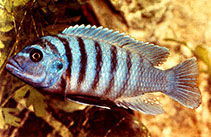
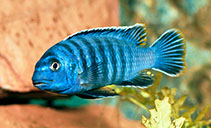
Épines dorsales (Total) : 16 - 19; Rayons mous dorsaux (Total) : 7 - 10; Épines anales: 3 - 4; Rayons mous anaux: 6 - 9. Diagnosis: The moderately sloped head, swollen rostral tip of the neurocranium, isognathous jaws, and the presence of bicuspid teeth in the outer rows of the jaws place this species in Maylandia (Ref. 27596). The absence of any interrupted pigment in the pale blue dorsal fin in combination with black bars on a blue ground colour distinguish this species from all other members of the genus (Ref. 27596).
Body shape (shape guide): fusiform / normal.
Adults are found in rocky areas which may be sediment-free and shallow or sediment-rich at somewhat deeper levels. They feed at right angles with the substrate by combing loose material from the biocover. Also feed on plankton in the open water (Ref. 5595).
Cycle de vie et comportement reproducteur
Maturité | Reproduction | Frai | Œufs | Fécondité | Larves
Produces up to 60 eggs.
Stauffer, J.R. Jr., N.J. Bowers, K.A. Kellogg and K.R. McKaye, 1997. A revision of the blue-black Pseudotropheus zebra (Teleostei: Cichlidae) complex from Lake Malawi, Africa, with a description of a new genus and ten new species. Proc. Acad. Nat. Sci. Philad. 148:189-230. (Ref. 27596)
Statut dans la liste rouge de l'IUCN (Ref. 130435: Version 2025-2 (Global))
Menace pour l'homme
Harmless
Utilisations par l'homme
Pêcheries: hautement commercial; Aquarium: hautement commercial
Outils
Articles particuliers
Télécharger en XML
Sources Internet
Estimations basées sur des modèles
Indice de diversité phylogénétique (Réf.
82804): PD
50 = 0.5000 [Uniqueness, from 0.5 = low to 2.0 = high].
Bayesian length-weight: a=0.01445 (0.00671 - 0.03113), b=2.99 (2.82 - 3.16), in cm total length, based on LWR estimates for this (Sub)family-body shape (Ref.
93245).
Niveau trophique (Réf.
69278): 2.3 ±0.1 se; based on diet studies.
Résilience (Réf.
120179): Haut, temps minimum de doublement de population inférieur à 15 mois (Preliminary K or Fecundity.).
Vulnérabilité de la pêche (Ref.
59153): Low vulnerability (10 of 100).
🛈