Environnement : milieu / zone climatique / profondeur / gamme de distribution
Écologie
marin récifal; profondeur 3 - 60 m (Ref. 5227). Tropical
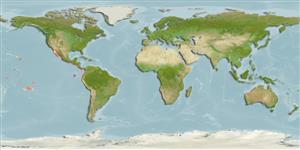
Eastern Pacific: Gulf of California (rare at Puerto Peñasco) to northern Peru.
Taille / Poids / Âge
Maturité: Lm ? range ? - ? cm
Max length : 20.3 cm TL mâle / non sexé; (Ref. 5592)
Description synthétique
Clés d'identification | Morphologie | Morphométrie
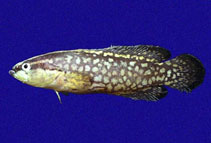
Épines dorsales (Total) : 2; Rayons mous dorsaux (Total) : 24 - 28; Rayons mous anaux: 14 - 18; Vertèbres: 24. Sides of body heavily marked with well-defined cream spots on dark background, extending onto head, cheeks and median fins; larger spots frequently ocellated; belly with articulated pattern, cream stripe on nape; dark band running laterally from lips to eye and continuing posteriorly to blend into background anterior to dorsal fin. Body and head, excluding lips and maxillary, with embedded scales. Dorsal spines 2 (rarely 3). Lower jaw not much projecting, lacking fleshy protuberance. Juvenile and adult with 4 large, distinct oval pores along preopercular margin and 4 pairs on ventral surface of lower jaw, except in > 6.5 cm SL specimens, most posterior pair may be divided into a few smaller pores (Ref. 40934).
Body shape (shape guide): short and / or deep; Cross section: compressed.
Little is known about this shy and secretive species. It lies motionless, often on its side, hidden in dark recesses on rocky reefs and along walls during the day. Actively hunts at night, preying on small fish (Ref. 5227).
Cycle de vie et comportement reproducteur
Maturité | Reproduction | Frai | Œufs | Fécondité | Larves
Thomson, D.A., 1987. Reef fishes of the Sea of Cortez. The rocky-shore fishes of the Gulf of California. The University of Arizona Press, Tucson. 302 p. (Ref. 5592)
Statut dans la liste rouge de l'IUCN (Ref. 130435: Version 2025-2 (Global))
Menace pour l'homme
Harmless
Utilisations par l'homme
Pêcheries: d'intérêt potentiel; Aquarium: potentiel
Outils
Articles particuliers
Télécharger en XML
Sources Internet
Estimations basées sur des modèles
Température préférée (Réf.
123201): 20.5 - 28.6, mean 25.8 °C (based on 86 cells).
Indice de diversité phylogénétique (Réf.
82804): PD
50 = 0.5005 [Uniqueness, from 0.5 = low to 2.0 = high].
Bayesian length-weight: a=0.01738 (0.00662 - 0.04565), b=3.01 (2.78 - 3.24), in cm total length, based on LWR estimates for this (Sub)family-body shape (Ref.
93245).
Niveau trophique (Réf.
69278): 3.8 ±0.7 se; based on size and trophs of closest relatives
Vulnérabilité de la pêche (Ref.
59153): Low vulnerability (10 of 100).
🛈
Nutriments (Ref.
124155): Calcium = 56.7 [31.5, 121.3] mg/100g; Iron = 0.57 [0.30, 1.08] mg/100g; Protein = 18.2 [16.3, 19.9] %; Omega3 = 0.138 [0.081, 0.227] g/100g; Selenium = 29.4 [16.2, 58.6] μg/100g; VitaminA = 87.5 [23.2, 381.7] μg/100g; Zinc = 1.05 [0.68, 1.61] mg/100g (wet weight);