>
Eupercaria/misc (Various families in series Eupercaria) >
Haemulidae (Grunts) > Plectorhinchinae
Etymology: Plectorhinchus: Greek, plektos = plaited + Greek, rhyngchos = snout (Ref. 45335).
More on author: Bleeker.
Milieu: milieu / Klimaatzone / Diepte / verspreidingsgebied
Ecologie
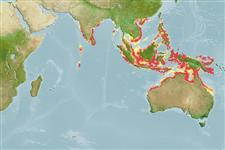
marien rifbewoner; diepte 5 - 40 m (Ref. 90102). Tropical; 22°N - 25°S, 72°E - 153°E
Indo-West Pacific: west coast of India; Philippines and Indonesia to Papua New Guinea, south to northern Australia (Ref. 9710).
Grootte / Gewicht / Leeftijd
Maturiteit: Lm ? range ? - ? cm
Max length : 50.0 cm TL mannelijk / geslacht onbekend; (Ref. 48635)
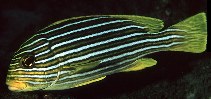
Dorsale stekels (totaal) : 12 - 13; Dorsale zachte stralen (totaal) : 19 - 22; Anale stekels: 3; Anale zachte stralen: 7 - 8. This species is distinguished by the following characters: chin with 6 pores, no median pit; gill rakers on first gill arch 7-9 + 1 + 17-20 = 26-29; Dorsal XII (rarely XIII), 19-22, 3rd-5th spines longest; lips fleshy, moderately swollen with age; scales ctenoid (rough to touch); lateral line tubed scales about 54-60; body depth 2.6-2.9 in SL; caudal fin rounded to slightly emarginate. Colour: brown to yellowish grey with 5 to 9 fairly narrow grey or white longitudinal stripes outlined with dark brown on body and continuing around snout; fins yellow, soft dorsal, caudal, and pectoral fins with darker stripes disappearing with age; eye and lips yellowish; mouth, tongue, and gill rakers scarlet; chin white; juveniles have fins striped and fewer stripes on body (Ref. 47695, 90102).
Body shape (shape guide): fusiform / normal; Cross section: compressed.
Occurs on coastal and seaward reefs. Adults on deep, current-prone slopes with rich invertebrate growth; juveniles on sheltered reefs nearby (Ref. 48635). Found singly, in small groups under ledges or large resting aggregations by day, forages for small invertebrates at night (Ref. 9710, 90102). Caught throughout its range; not common. Rarely marketed in India (Ref. 3412). Taken by handline and spear. Marketed fresh, a small quantity is salted (Ref. 47695).
Levenscyclus en paargedrag
Maturiteit | Voortplanting | Paaien | Eieren | Fecunditeit | Larven
Oviparous, distinct pairing during breeding (Ref. 205).
McKay, R.J., 1984. Haemulidae. In W. Fischer and G. Bianchi (eds.) FAO species identification sheets for fishery purposes. Western Indian Ocean (Fishing Area 51). Vol. 2. FAO, Rome. pag. var. (Ref. 3412)
Status op de Rode Lijst van het IUCN (Ref. 130435: Version 2025-2 (Global))
Gevaar voor de mens
Harmless
Gebruik door de mens
Visserij: commercieel
Tools
Speciale rapporten
Download XML
Internetbronnen
Schattingen op basis van modellen
Gewenste temperatuur (Ref.
123201): 27 - 29.3, mean 28.7 °C (based on 1858 cells).
Fylogenetische diversiteitsindex (Ref.
82804): PD
50 = 0.5000 [Uniqueness, from 0.5 = low to 2.0 = high].
Bayesian length-weight: a=0.01585 (0.00982 - 0.02557), b=3.02 (2.88 - 3.16), in cm total length, based on LWR estimates for this species & Genus-body shape (Ref.
93245).
Trofisch niveau (Ref.
69278): 4.0 ±0.66 se; based on food items.
Weerstandsvermogen (Ref.
120179): Gemiddeld, minimale populatieverdubbelingstijd 1,4-4,4 jaar (Preliminary K or Fecundity.).
Kwetsbaarheid van de visserij (Ref.
59153): Moderate vulnerability (40 of 100).
🛈
Voedingsstoffen (Ref.
124155): Calcium = 33.7 [12.0, 63.5] mg/100g; Iron = 0.51 [0.27, 0.96] mg/100g; Protein = 19.5 [17.7, 21.3] %; Omega3 = 0.134 [0.073, 0.216] g/100g; Selenium = 30.9 [18.2, 52.3] μg/100g; VitaminA = 81.8 [33.1, 199.7] μg/100g; Zinc = 0.995 [0.688, 1.473] mg/100g (wet weight);