>
Eupercaria/misc (Various families in series Eupercaria) >
Lutjanidae (Snappers) > Etelinae
Etymology: Aphareus: Greek, aphareys, -eos = water wings under the belly of female tunna (Ref. 45335).
More on author: Cuvier.
สิ่งแวดล้อม : สิ่งแวดล้อม / เขตภูมิอากาศ / ระดับความลึก / ระยะการกระจายสินค้า
นิเวศวิทยา
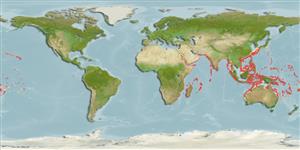
เกี่ยวกับทะเล,น้ำเค็ม เกี่ยวกับหินโสโครก; ระดับความลึก 100 - 330 m (Ref. 37816). Tropical; 35°N - 35°S, 24°E - 150°W (Ref. 55)
Indo-Pacific: East Africa to the Hawaiian Islands, north to the Ryukyu and Ogasawara islands, south to Australia. Southeast Atlantic: Port Alfred, South Africa (Ref. 11228).
ขนาด / น้ำหนัก / อายุ
วัยเจริญพันธุ์: Lm ? range ? - ? cm
Max length : 110 cm TL เพศผู้/กระเทย; (Ref. 5484); common length : 79.0 cm SL เพศผู้/กระเทย; (Ref. 37816); น้ำหนักสูงสุดที่มีการรายงาน: 11.3 kg (Ref. 4887); อายุสูงสุดที่ได้รายงาน: 16 ปี (Ref. 82366)
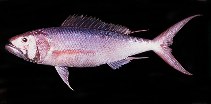
เงี่ยงครีบหลัง (รวม) : 10; ก้านครีบอ่อนที่หาง (รวม) : 10 - 11; เงี่ยงครีบก้น: 3; ก้านครีบอ่อนที่ก้น: 8. This species is distinguished by the following characters: body elongate and laterally compressed; lower jaw protruding; premaxillae not protrusible, fixed by a frenum; teeth in jaws are extremely small, minute in large adults; roof of mouth toothless; maxilla without scales or longitudinal ridges; interorbital region flattened; gill openings extending far anterior to orbit; gill rakers on first gill arch 16 - 19 + 32-35 = 49-52; last soft ray of both dorsal and anal fins well produced, longer than next to last ray; caudal fin forked; D X,11 (occasionally 10); membranes of dorsal and anal fins without scales; tubed lateral-line scales 69-75. Colour of body blue-grey or mauve to overall reddish; margin of maxilla black; in some specimens, at least, inside of mouth, gill chamber, and gills shining silver; fins yellowish to reddish except pelvic and anal fins sometimes whitish (Ref. 9821).
Body shape (shape guide): fusiform / normal; Cross section: oval.
Adults inhabit reefs and rocky bottom areas to depths of at least 100 m (Ref. 4887). Found in pelagic and benthopelagic waters (Ref. 58302). They feed on fishes, squids and crustaceans (Ref. 4887). Marketed fresh (Ref. 37816).
Allen, G.R., 1985. FAO Species Catalogue. Vol. 6. Snappers of the world. An annotated and illustrated catalogue of lutjanid species known to date. FAO Fish. Synop. 125(6):208 p. Rome: FAO. (Ref. 55)
สถานะบัญชีแดงของ IUCN (Ref. 130435: Version 2025-2 (Global))
ภัยคุกคามต่อมนุษย์
Harmless
การใช้ของมนุษย์
การประมง: การค้า; การตกปลาเป็นกีฬา: ใช่
เครื่องมือ
รายงานพิเศษ
ดาวน์โหลด XML
แหล่งที่มาจากอินเตอร์เน็ต
การประมาณค่าตามแบบจำลอง
อุณหภูมิที่ต้องการ (อ้างอิง
123201): 14.1 - 23.3, mean 18.4 °C (based on 229 cells).
ดัชนีความหลากหลายทางวิวัฒนาการ (อ้างอิง
82804): PD
50 = 0.7500 [Uniqueness, from 0.5 = low to 2.0 = high].
Bayesian length-weight: a=0.01549 (0.01243 - 0.01930), b=2.93 (2.87 - 2.99), in cm total length, based on LWR estimates for this species (Ref.
93245).
ระดับชั้นอาหาร (อ้างอิง
69278): 4.1 ±0.57 se; based on food items.
ความสามารถในการกลับคืนสู่ปกติ (อ้างอิง
120179): ต่ำ, เวลาต่ำสุดที่จะทำให้ประชากรเพิ่มขึ้นเป็น 2 เท่าใช้เวลา 4.5 - 14 ปี (K=0.16; tmax=16;).
ความเสี่ยงต่อการตกปลา (Ref.
59153): Moderate to high vulnerability (53 of 100).
🛈
ความเสี่ยงต่อสภาพภูมิอากาศ (Ref.
125649): High to very high vulnerability (73 of 100).
🛈
สารอาหาร (Ref.
124155): Calcium = 19.9 [11.6, 34.2] mg/100g; Iron = 0.48 [0.26, 0.79] mg/100g; Protein = 19 [17, 21] %; Omega3 = 0.147 [0.094, 0.225] g/100g; Selenium = 57.5 [34.5, 100.0] μg/100g; VitaminA = 80.3 [28.6, 249.2] μg/100g; Zinc = 0.704 [0.502, 0.973] mg/100g (wet weight);