Élasmobranches (requins et raies) (sharks and rays) >
Carcharhiniformes (Ground sharks) >
Pentanchidae (Deepwater catsharks)
Etymology: Holohalaelurus: holos (Gr.), whole or entire, i.e., being a form of Halaeurus without any labial folds or grooves in the mouth (See ETYFish); regani: In honor of English ichthyologist Charles Tate Regan (1878-1943), Natural History Museum (London), who described many South African fishes (See ETYFish).
Eponymy: Charles Tate Regan (1878–1943) was a British ichthyologist. [...] (Ref. 128868), visit book page.
Environnement : milieu / zone climatique / profondeur / gamme de distribution
Écologie
marin bathydémersal; profondeur ? - 1075 m (Ref. 75585), usually 150 - 300 m (Ref. 75585). Deep-water; 4°S - 37°S
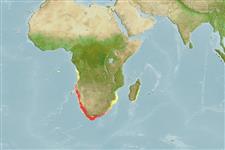
Indian Ocean from Durban, kwaZulu-Natal, South Africa, southwards and westwards to Cape Agulhas; westward into the Atlantic Ocean; northwards to southeast of Lüderitz, Namibia.
Taille / Poids / Âge
Maturité: Lm ? range ? - ? cm
Max length : 69.0 cm TL mâle / non sexé; (Ref. 5578)
Description synthétique
Clés d'identification | Morphologie | Morphométrie
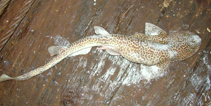
Épines dorsales (Total) : 0; Épines anales: 0. A broad-headed catshark with crowded dark brown spots on a yellowish background, producing a net-like pattern of light lines; underside white with small black pores; no labial furrows (Ref. 5578). Specimens less than 23 cm TL blackish with white side spots (Ref. 5578).
Body shape (shape guide): elongated.
Found on the outer continental shelf and upper slope, on or near the bottom (Ref. 244). This species has been reported to prefer temperate to cool temperate waters, but may also be found in subtropical waters; apparently prefer 200-300 m depths on the west coast and 100-200 m depths on the south coast; and, a common by catch of demersal trawlers (Ref. 75585). Feeds mainly on pelagic bony fishes, also fish offal, hagfish eggs, crustaceans, and cephalopods (Ref. 5578). Oviparous (Ref. 50449).
Cycle de vie et comportement reproducteur
Maturité | Reproduction | Frai | Œufs | Fécondité | Larves
Oviparous, with one egg laid per oviduct at a time (Ref. 5578). Embryos feed solely on yolk (Ref. 50449).
Compagno, L.J.V., 1984. FAO Species Catalogue. Vol. 4. Sharks of the world. An annotated and illustrated catalogue of shark species known to date. Part 2 - Carcharhiniformes. FAO Fish. Synop. 125(4/2):251-655. Rome: FAO. (Ref. 244)
Statut dans la liste rouge de l'IUCN (Ref. 130435: Version 2025-2 (Global))
Menace pour l'homme
Harmless
Utilisations par l'homme
Outils
Articles particuliers
Télécharger en XML
Sources Internet
Estimations basées sur des modèles
Température préférée (Réf.
123201): 9 - 15.8, mean 10.5 °C (based on 54 cells).
Indice de diversité phylogénétique (Réf.
82804): PD
50 = 0.5312 [Uniqueness, from 0.5 = low to 2.0 = high].
Bayesian length-weight: a=0.00347 (0.00172 - 0.00698), b=3.08 (2.90 - 3.26), in cm total length, based on LWR estimates for this (Sub)family-body shape (Ref.
93245).
Niveau trophique (Réf.
69278): 4.2 ±0.5 se; based on diet studies.
Résilience (Réf.
120179): Faible, temps minimum de doublement de population : 4,5 à 14 années (Fec assumed to be <100).
Vulnérabilité de la pêche (Ref.
59153): Moderate to high vulnerability (48 of 100).
🛈
Nutriments (Ref.
124155): Calcium = 8.87 [1.57, 53.86] mg/100g; Iron = 0.345 [0.073, 1.156] mg/100g; Protein = 17.2 [14.0, 20.3] %; Omega3 = 0.222 [0.091, 0.543] g/100g; Selenium = 13 [4, 40] μg/100g; VitaminA = 13.9 [3.1, 62.5] μg/100g; Zinc = 0.294 [0.145, 0.560] mg/100g (wet weight);