>
Eupercaria/misc (Various families in series Eupercaria) >
Labridae (Wrasses) > Hypsigenyinae
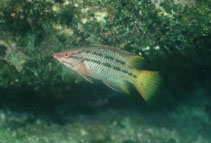
Etymology: Bodianus: Bodianus after Bodiano or Pudiano, from the Portuguese pudor, meaning modesty (Jordan & Evermann, 1896); diplotaenia: Name from the Greek diploos, meaning 'twofold', and feminine noun tainia for ribbon, referring to the two prominent dark stripes on the body of juveniles and initial phase adults (Ref. 75973).
More on author: Gill.
Ambiente: milieu / zona climatica / distribuzione batimetrica / gamma di distribuzione
Ecologia
marino associati a barriera corallina; distribuzione batimetrica 5 - 76 m (Ref. 9311), usually 5 - 18 m (Ref. 9311). Subtropical; 32°N -
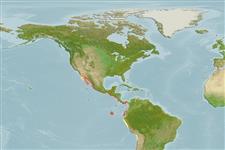
Eastern Pacific: Guadalupe Island and throughout the Gulf of California to Chile, including the Cocos, Malpelo, Revillagigedo and the Galapagos islands.
Dimensione / Peso / Età
Maturità: Lm ? range ? - ? cm
Max length : 76.0 cm TL maschio/sesso non determinato; (Ref. 5592); common length : 45.0 cm TL maschio/sesso non determinato; (Ref. 55763); peso massimo pubblicato: 9.0 kg (Ref. 5592)
Breve descrizione
Chiavi di identificazione | Morfologia | Morfometria
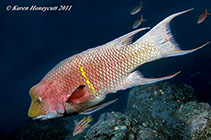
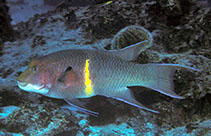
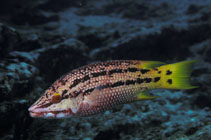
Body moderately deep and compressed; head large and pointed; teeth caniniform, enlarged, and somewhat crooked, two anterior pairs in each jaw; dorsal fin with 12 spines; posterior rays of anal and dorsal fins forming filamentous lobes; lower branch of first gill arch with 12 to 13 gill rakers; very large individuals blue, with a narrow, yellow, vertical bar immediately behind the posterior edge of the pectoral fin, juveniles red or reddish brown; females with 2 longitudinal black stripes (Ref. 55763).
Body shape (shape guide): fusiform / normal.
Adults inhabit rocky or coral areas (Ref. 9311). Sometimes also found on sandy bottoms and where marine plants abound (Ref. 9311). Solitary or forms aggregations of only a few individuals. Feed on crabs, brittle stars, mollusks, and sea urchins (Ref. 9311). At night, they agglomerate in cracks and crevices of rocks and caves to sleep (Ref. 9311). Marketed fresh (Ref. 9311). Starts life as a female, later becoming a functional male. Males defend temporary reproductive territories called leks. Sex change may be due to local social conditions, but it may also have a genetic component, since the reversal occurs over a limited size range (Ref. 28023). Oviparous, distinct pairing during breeding (Ref. 205).
Ciclo vitale e comportamento di accoppiamento
Maturità | Riproduzione | Deposizione | Uova | Fecondità | Larve
Oviparous, distinct pairing during breeding (Ref. 205).
Thomson, D.A., 1987. Reef fishes of the Sea of Cortez. The rocky-shore fishes of the Gulf of California. The University of Arizona Press, Tucson. 302 p. (Ref. 5592)
Stato della Lista Rossa IUCN (Ref. 130435: Version 2025-2 (Global))
Minaccia per l'uomo
Harmless
Usi umani
Pesca: commerciale; Acquario: Commerciale
Strumenti
Rapporti speciali
Scarica XML
Fonti Internet
Stime basate su modelli
Temperatura preferita (Fonte Biblio.
123201): 20.6 - 28.9, mean 26.2 °C (based on 286 cells).
Indice di diversità filogenetica (Fonte Biblio.
82804): PD
50 = 0.5000 [Uniqueness, from 0.5 = low to 2.0 = high].
Bayesian length-weight: a=0.01047 (0.00493 - 0.02225), b=3.08 (2.90 - 3.26), in cm total length, based on LWR estimates for this Genus-body shape (Ref.
93245).
Livello trofico (Fonte Biblio.
69278): 3.4 ±0.46 se; based on food items.
Resilienza (Fonte Biblio.
120179): Basso, tempo minimo di raddoppiamento della popolazione 4.5 - 14 anni (Preliminary K or Fecundity.).
Vulnerabilità della pesca (Ref.
59153): Moderate to high vulnerability (50 of 100).
🛈
Nutrienti (Ref.
124155): Calcium = 18.5 [9.0, 35.3] mg/100g; Iron = 0.479 [0.265, 0.904] mg/100g; Protein = 19.3 [16.4, 21.5] %; Omega3 = 0.189 [0.109, 0.326] g/100g; Selenium = 19.3 [9.6, 36.8] μg/100g; VitaminA = 44.1 [13.7, 174.4] μg/100g; Zinc = 0.775 [0.531, 1.280] mg/100g (wet weight);