>
Beloniformes (Needle fishes) >
Hemiramphidae (Halfbeaks)
Etymology: Hyporhamphus: Greek, hypo = under + Greek, rhamphos = beak, bill (Ref. 45335).
Eponymy: Jean René Constant Quoy (1790–1869) was a French naval surgeon and zoologist who named many species, often with Joseph Paul Gaimard (q. [...] (Ref. 128868), visit book page.
More on author: Valenciennes.
Environnement : milieu / zone climatique / profondeur / gamme de distribution
Écologie
marin; eau douce; saumâtre pelagic-neritic; profondeur 0 - ? m. Tropical
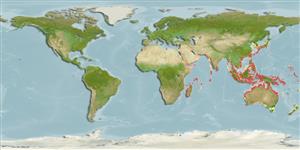
Indo-West Pacific: in western Pacific, known from Thailand, the East Indies, Borneo, and the Philippines north to China and Nagasaki, Japan, south to New Guinea and northern half of Australia.
Longueur à la première maturité / Taille / Poids / Âge
Maturité: Lm ?, range 13 - ? cm
Max length : 31.2 cm SL mâle / non sexé; (Ref. 9843)
Épines dorsales (Total) : 0; Rayons mous dorsaux (Total) : 14 - 17; Épines anales: 0; Rayons mous anaux: 13 - 17; Vertèbres: 51 - 56. Prolonged, beak-like lower jaw, shorter than head length, its length contained in 4.7-8.6 times in SL and 1.2-2.0 times in head length; upper jaw short, scaly, blunt and rounded, its width contained in 0.5-0.6 times in its length; preorbital bone 1.75-2.15 times in diameter of orbit and 0.9-1.15 times in length of upper jaw; preorbital ridge present; posterior branch to preorbital lateral line canal present. Total number of gill rakers on first arch 26-39; dorsal fin rays 14-17, usually 16; anal fin rays 13-17, usually 15 or 16. Caudal fin forked, with lower lobe longer than upper.
Body shape (shape guide): elongated.
Inhabits more turbid and estuarine situations than does Hyporhamphus dussumieri and is not found in oceanic islands (Ref. 9843). May enter rivers (Ref. 559). Found in medium to large-sized rivers of the lower Mekong (Ref. 12975). Occurs in schools (Ref. 3132). Taken mostly with shore seines; marketed mostly fresh and dried salted (Ref. 9843).
Cycle de vie et comportement reproducteur
Maturité | Reproduction | Frai | Œufs | Fécondité | Larves
Collette, B.B. and J. Su, 1986. The halfbeaks (Pisces, Beloniformes, Hemiramphidae) of the Far East. Proc. Acad. Nat. Sci. Philadelphia 138(1):250-301. (Ref. 10943)
Statut dans la liste rouge de l'IUCN (Ref. 130435: Version 2025-2 (Global))
Menace pour l'homme
Harmless
Utilisations par l'homme
Pêcheries: intérêt commercial mineur
Outils
Articles particuliers
Télécharger en XML
Sources Internet
Estimations basées sur des modèles
Température préférée (Réf.
123201): 24.1 - 29.3, mean 28.4 °C (based on 3099 cells).
Indice de diversité phylogénétique (Réf.
82804): PD
50 = 0.5000 [Uniqueness, from 0.5 = low to 2.0 = high].
Bayesian length-weight: a=0.00234 (0.00131 - 0.00420), b=3.08 (2.93 - 3.23), in cm total length, based on LWR estimates for this species & Genus-body shape (Ref.
93245).
Niveau trophique (Réf.
69278): 3.0 ±0.0 se; based on diet studies.
Résilience (Réf.
120179): Haut, temps minimum de doublement de population inférieur à 15 mois (Preliminary K or Fecundity.).
Vulnérabilité de la pêche (Ref.
59153): Low to moderate vulnerability (28 of 100).
🛈