>
Ovalentaria/misc (Various families in series Ovalentaria) >
Pomacentridae (Damselfishes) > Glyphisodontinae
Etymology: Abudefduf: Arabic, abu = father; this fish is the leader of the reef against other species (Ref. 45335).
Eponymy: Dr Franz Hermann ‘Fritz’ Troschel (1810–1882) was a German zoologist, malacologist, herpetologist, and ichthyologist. [...] (Ref. 128868), visit book page.
More on author: Gill.
Entorno: milieu / zona climática / rango de profundidad / gama de distribución
Ecología
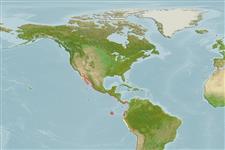
marino asociado a arrecife; no migratorio; rango de profundidad 1 - 12 m (Ref. 5592). Tropical; 32°N - 18°S, 115°W - 73°W
Eastern Pacific: throughout the Gulf of California and from Bahía San Juanico, Baja California, Mexico to northern Peru, the Galapagos Islands and other offshore islands.
Tamaño / Peso / Edad
Madurez: Lm ? range ? - ? cm
Max length : 20.0 cm TL macho / no sexado; (Ref. 55763); common length : 10.0 cm TL macho / no sexado; (Ref. 55763)
Descripción breve
Claves de identificación | Morfología | Morfometría
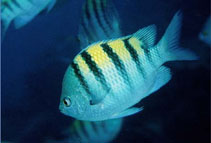
Espinas dorsales (total) : 13; Radios blandos dorsales (total) : 12 - 13; Espinas anales: 2; Radios blandos anales: 10 - 13. With black spot on pectoral fin base.
Body shape (shape guide): short and / or deep; Cross section: compressed.
Adults inhabit rocky and coral reefs (Ref. 9334). Usually in large aggregations. These diurnal feeders feed on plankton at the surface or mid-water; also graze on benthic invertebrates and algae on the reef. Breed during early summer in the Gulf and continues throughout the summer until fall. This fish is a warm-water, stenothermal species. Juveniles of second year class have been observed cleaning schools of striped mullet, halfbeaks and needlefish (Ref. 5592). Oviparous, distinct pairing during breeding (Ref. 205). Eggs are demersal and adhere to the substrate (Ref. 205). Males guard and aerate the eggs (Ref. 205).
Ciclo vital y comportamiento de apareamiento
Madurez | Reproducción | Puesta | Huevos | Fecundidad | Larva
Oviparous, distinct pairing during breeding (Ref. 205). Eggs are demersal and adhere to the substrate (Ref. 205). Males guard and aerate the eggs (Ref. 205).
Allen, G.R., 1991. Damselfishes of the world. Mergus Publishers, Melle, Germany. 271 p. (Ref. 7247)
Situación en la Lista Roja de la UICN (Ref. 130435: Version 2025-2 (Global))
Amenaza para el ser humano
Harmless
Usos humanos
Herramientas
Informes especiales
Descargar XML
Fuentes de Internet
Estimaciones basadas en modelos
Temperatura preferida (Referencia
123201): 22.3 - 29.1, mean 26.4 °C (based on 257 cells).
Índice de diversidad filogenética (Referencia
82804): PD
50 = 0.5000 [Uniqueness, from 0.5 = low to 2.0 = high].
Bayesian length-weight: a=0.02239 (0.00963 - 0.05206), b=3.06 (2.87 - 3.25), in cm total length, based on LWR estimates for this Genus-body shape (Ref.
93245).
Nivel trófico (Referencia
69278): 3.0 ±0.32 se; based on food items.
Resiliencia (Referencia
120179): Medio, población duplicada en un tiempo mínimo de 1.4-4.4 años (Preliminary K or Fecundity.).
Vulnerabilidad pesquera (Ref.
59153): Low vulnerability (10 of 100).
🛈
Nutrientes (Ref.
124155): Calcium = 74.3 [39.6, 117.5] mg/100g; Iron = 0.635 [0.383, 1.011] mg/100g; Protein = 18.5 [17.3, 19.5] %; Omega3 = 0.0977 [, ] g/100g; Selenium = 21.6 [12.5, 39.4] μg/100g; VitaminA = 76.8 [22.8, 242.4] μg/100g; Zinc = 1.42 [0.98, 2.04] mg/100g (wet weight);