Élasmobranches (requins et raies) (sharks and rays) >
Myliobatiformes (Stingrays) >
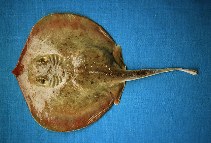
Urotrygonidae (American round stingrays)
Etymology: Urotrygon: Greek, oura = tail + Greek, trygon = a sting ray (Ref. 45335).
More on author: Günther.
Environnement : milieu / zone climatique / profondeur / gamme de distribution
Écologie
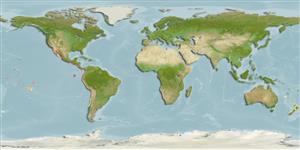
marin démersal; profondeur 1 - 60 m (Ref. 58018). Subtropical; 32°N -
Eastern Pacific: Gulf of California to Peru and Chile.
Taille / Poids / Âge
Maturité: Lm ? range ? - ? cm
Max length : 41.9 cm TL mâle / non sexé; (Ref. 9265); common length : 35.0 cm TL mâle / non sexé; (Ref. 9265)
Found on soft bottoms of shallow water (Ref. 9265). Feeds mainly on small crustaceans, mollusks, polychaete worms and fishes (Ref. 37955).
Cycle de vie et comportement reproducteur
Maturité | Reproduction | Frai | Œufs | Fécondité | Larves
Ovoviviparous.
McEachran, J.D., 1995. Urolophidae. Rayas redondas. p. 786-792. In W. Fischer, F. Krupp, W. Schneider, C. Sommer, K.E. Carpenter and V. Niem (eds.) Guia FAO para Identification de Especies para lo Fines de la Pesca. Pacifico Centro-Oriental. 3 Vols. FAO, Rome. (Ref. 9265)
Statut dans la liste rouge de l'IUCN (Ref. 130435: Version 2025-2 (Global))
Utilisations par l'homme
Outils
Articles particuliers
Télécharger en XML
Sources Internet
Estimations basées sur des modèles
Température préférée (Réf.
123201): 19.4 - 28.6, mean 24.7 °C (based on 86 cells).
Indice de diversité phylogénétique (Réf.
82804): PD
50 = 0.5001 [Uniqueness, from 0.5 = low to 2.0 = high].
Bayesian length-weight: a=0.01660 (0.00792 - 0.03479), b=3.10 (2.91 - 3.29), in cm total length, based on LWR estimates for this species & (Sub)family-body (Ref.
93245).
Niveau trophique (Réf.
69278): 3.6 ±0.53 se; based on food items.
Résilience (Réf.
120179): Faible, temps minimum de doublement de population : 4,5 à 14 années (Assuming fecundity<100).
Vulnérabilité de la pêche (Ref.
59153): Low to moderate vulnerability (32 of 100).
🛈