>
Carangaria/misc (Various families in series Carangaria) >
Latidae (Lates perches)
Etymology: Psammoperca: Greek, psammos = sand + Greek,perke = perch (Ref. 45335).
More on author: Cuvier.
Milieu: milieu / Klimaatzone / Diepte / verspreidingsgebied
Ecologie
marien; brak water rifbewoner; diepte 3 - 12 m (Ref. 90102). Tropical
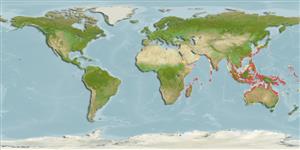
Indo-West Pacific: Bay of Bengal, Indo-Australian Archipelago and northern Australia to the Philippines, China Sea and Japan (Ref. 2334). Found in the Mekong delta (Ref. 12693).
Lengte bij maturiteit / Grootte / Gewicht / Leeftijd
Maturiteit: Lm ?, range 28 - ? cm
Max length : 47.0 cm TL mannelijk / geslacht onbekend; (Ref. 2334); common length : 25.0 cm TL mannelijk / geslacht onbekend; (Ref. 9799)
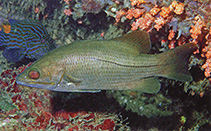
Dorsale stekels (totaal) : 8; Dorsale zachte stralen (totaal) : 12 - 14; Anale stekels: 3; Anale zachte stralen: 8; Wervels: 14. This species is distinguished from Psammoperca datnioides by the following set of characters: Colouration: when alive, the head and body brownish dark and often golden in colour; pored lateral-line scales yellow-edged; and similar yellowish brown colour in preserved specimens; lower counts of pored lateral line scales 46-48; hind margin of maxilla reaching slightly short of hind margin of eye when mouth closed; tiny scales that are not seen with naked eye, but visible through binocular scope, on the posterior uppermost part of maxilla; pelvic-fin spine subequal to 4th dorsal spine; circumpeduncular scale 21-22; moderately lesser body depth, 32-36% (mean 36%) of SL; lower counts, 5½ / 7½-9½ scale rows above and below lateral line; gill rakers 7 (including 6 rudiments) + 1 + 11 (including 3 rudiments) = 19 (9 rudiments); last dorsal-fin spine / penultimate dorsal-fin spine 1.5-1.7 (Ref. 124584).
Body shape (shape guide): fusiform / normal; Cross section: compressed.
Inhabits rocky or coral reefs, frequently in weedy areas, usually in holes and crevices by day. Enters estuaries (Ref. 4833). Forages on fishes and crustaceans at night (Ref. 9710). Mainly marketed fresh. In Hong Kong sold live in fish markets (Ref. 27253).
Levenscyclus en paargedrag
Maturiteit | Voortplanting | Paaien | Eieren | Fecunditeit | Larven
Iwatsuki, Y., S.J. Newman, F. Tanaka and B.C. Russell, 2018. Validity of Psammoperca datnioides Richardson 1848 and redescriptions of P. waigiensis Cuvier in Cuvier & Valenciennes 1828 and Hypopterus macropterus (Günther 1859) in the family Latidae (Perciformes) from the Indo-West Pacific. Zootaxa 4402(3):467-486. (Ref. 124584)
Status op de Rode Lijst van het IUCN (Ref. 130435: Version 2025-2 (Global))
Gevaar voor de mens
Harmless
Gebruik door de mens
Visserij: commercieel; sportvis: ja
Tools
Speciale rapporten
Download XML
Internetbronnen
Schattingen op basis van modellen
Gewenste temperatuur (Ref.
123201): 24.7 - 29.3, mean 28.4 °C (based on 2981 cells).
Fylogenetische diversiteitsindex (Ref.
82804): PD
50 = 0.7501 [Uniqueness, from 0.5 = low to 2.0 = high].
Bayesian length-weight: a=0.01047 (0.00493 - 0.02225), b=3.02 (2.83 - 3.21), in cm total length, based on LWR estimates for this (Sub)family-body shape (Ref.
93245).
Trofisch niveau (Ref.
69278): 4.0 ±0.67 se; based on food items.
Weerstandsvermogen (Ref.
120179): Gemiddeld, minimale populatieverdubbelingstijd 1,4-4,4 jaar (Preliminary K or Fecundity.).
Kwetsbaarheid van de visserij (Ref.
59153): Moderate vulnerability (37 of 100).
🛈
Voedingsstoffen (Ref.
124155): Calcium = 57.9 [28.1, 102.6] mg/100g; Iron = 0.579 [0.300, 1.063] mg/100g; Protein = 20 [18, 22] %; Omega3 = 0.14 [0.09, 0.21] g/100g; Selenium = 24.4 [13.5, 47.5] μg/100g; VitaminA = 62.7 [17.8, 226.9] μg/100g; Zinc = 1.19 [0.81, 1.83] mg/100g (wet weight);