>
Tetraodontiformes (Puffers and filefishes) >
Tetraodontidae (Puffers) > Tetraodontinae
Etymology: Takifugu: A Japanese word with several meanings; taki = waterfall + fugu = fish; it could be also understood as taki = to be cooked in liquid + fugu = a venomous fish.
More on authors: Temminck & Schlegel.
Môi trường: môi trường / vùng khí hậu / Mức độ sâu / phạm vi phân phối
Sinh thái học
biển; nước ngọt; thuộc về nước lợ gần đáy; không di cư. Temperate; 46°N - 21°N, 119°E - 142°E
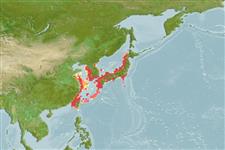
Northwest Pacific: western part of the Sea of Japan and the East China and Yellow seas northward to Muroran, Hokkaido, Japan.
Bộ gần gũi / Khối lượng (Trọng lượng) / Tuổi
Chín muồi sinh dục: Lm ? range ? - ? cm
Max length : 80.0 cm TL con đực/không giới tính; (Ref. 56527); common length : 40.0 cm TL con đực/không giới tính; (Ref. 637)
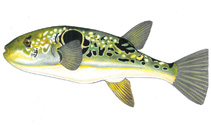
Các tia vây lưng cứng (tổng cộng) : 0; Các vây lưng mềm (tổng cộng) : 16 - 19; Tia cứng vây hậu môn: 0; Tia mềm vây hậu môn: 13 - 16; Động vật có xương sống: 21 - 22. Body covered with prickles; presence of a large round black blotch edged with a white line on side just behind pectoral fin (Ref. 559).
Body shape (shape guide): fusiform / normal.
Adults are found in inlet waters, occasionally entering brackish waters. Fingerlings are often seen in brackish river mouths (Ref. 58920). Move offshore with growth. Breed in the sea (Ref. 58920) from March to May; attach eggs to rocks in shingly areas at depths of around 20 m. Liver and ovaries extremely toxic, intestines slightly toxic; flesh, skin and testes not poisonous. Juveniles resemble Takifugu niphobles (Ref. 637). A prized food fish in Japan. Said to be commercially cultured in Japan at present. Used in Chinese medicine (Ref. 12166). One of the first vertebrates whose genome has been sequenced completely, 31,059 genes coding for 33,609 proteins (Ref. 58917).
Masuda, H., K. Amaoka, C. Araga, T. Uyeno and T. Yoshino, 1984. The fishes of the Japanese Archipelago. Vol. 1. Tokai University Press, Tokyo, Japan. 437 p. (text). (Ref. 559)
Tình trạng Sách đỏ IUCN (Ref. 130435: Version 2025-2 (Global))
Mối đe dọa đối với con người
Poisonous to eat (Ref. 637)
Sử dụng của con người
Các nghề cá: tính thương mại cao; Nuôi trồng thủy sản: tính thương mại
Các công cụ
Báo cáo đặc biệt
Tải xuống XML
Các nguồn internet
Ước tính dựa trên mô hình
Nhiệt độ ưa thích (Tài liệu tham khảo
123201): 13.5 - 23, mean 19 °C (based on 96 cells).
Chỉ số đa dạng phát sinh loài (Tài liệu tham khảo
82804): PD
50 = 0.5000 [Uniqueness, from 0.5 = low to 2.0 = high].
Bayesian length-weight: a=0.01660 (0.00743 - 0.03706), b=2.92 (2.74 - 3.10), in cm total length, based on LWR estimates for this (Sub)family-body shape (Ref.
93245).
Mức dinh dưỡng (Tài liệu tham khảo
69278): 3.6 ±0.57 se; based on food items.
Thích nghi nhanh (Tài liệu tham khảo
120179): Trung bình, thời gian nhân đôi của chủng quần tối thiểu là 1.4 - 4.4 năm (K=0.15-0.17; assuming tm<5).
Sự dễ bị tổn thương của nghề đánh cá (Ref.
59153): Low to moderate vulnerability (30 of 100).
🛈
Chất dinh dưỡng (Ref.
124155): Calcium = 33.8 [12.1, 75.6] mg/100g; Iron = 0.417 [0.219, 0.855] mg/100g; Protein = 18.9 [16.7, 21.2] %; Omega3 = 0.664 [0.289, 1.400] g/100g; Selenium = 17.1 [7.6, 37.7] μg/100g; VitaminA = 5.76 [2.01, 17.07] μg/100g; Zinc = 0.506 [0.365, 0.732] mg/100g (wet weight);