Lingkungan: lingkungan / zona iklim / kisaran kedalaman / jangkauan distribusi
Ekologi
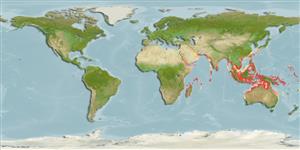
laut; air tawar; payau dasar (demersal); amphidromus (Ref. 51243). Tropical; 27°N - 20°S, 72°E - 177°W
Indo-West Pacific: west and south coasts of India and off Sri Lanka eastward along the coasts of Bangladesh and Myanmar, through the Indo-Australian Archipelago and the Philippines as far as Papua New Guinea.
Ukuran / Berat / umur
Kematangan: Lm ? range ? - ? cm
Max length : 111 cm TL jantan/; (Ref. 127983); common length : 80.0 cm TL jantan/; (Ref. 3478)
deskripsi pendek
Kunci identifiaksi (pengenalan) | Morfologi | Morfometrik
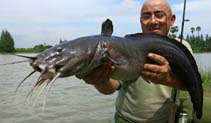
A plain dusky-brown species with a black dorsal fin tip. Shows banded pattern at night. Distinguished from adult Plotosus lineatus by its long barbels on the nostrils that can reach pass the eyes.
Body shape (shape guide): elongated.
Adults found mostly in estuaries and lagoons, and sometimes up rivers in nearly fresh waters. They occur in the lower parts of rivers in freshwater or brackish water and in coastal seas (Ref. 12693, 48635). It is reported to have an extended breeding season and likely spawns in brackish water, based on optimal sperm survival at 0.9 % salinity; produces relatively few large eggs, consistent with parental care and it is possible that male fish construct nests and guard their fry (Ref. 127983), Maximum length of 150 cm TL is without actual specimen (Ref. 3478). Juveniles may occur in dense aggregations (Ref. 9801). Feed on crustaceans, mollusks and fishes. Spines associated with anterior fins have potent venom. Marketed mostly fresh.
Siklus hidup dan perilaku kawin
Kematangan | Reproduksi, perkembang biakan | Pemijahan | telur-telur | Fekunditas | Larva
Gomon, J.R., 1984. Plotosidae. In W. Fischer and G. Bianchi (eds.) FAO species identification sheets for fishery purposes. Western Indian Ocean fishing area 51. Vol. 3. (Ref. 3478)
Status IUCN Red List (Ref. 130435: Version 2025-2 (Global))
penggunaan manusia
Perikanan: komersial
Alat, peralatan
laporan khas
muat turun XML
Sumber internet
Estimasi berdasarkan model
Suhu yang disukai (Acuan
123201): 25.1 - 29.1, mean 28.3 °C (based on 1244 cells).
Indeks keanekaragaman filogenetik (Acuan
82804): PD
50 = 0.5020 [Uniqueness, from 0.5 = low to 2.0 = high].
Bayesian length-weight: a=0.00501 (0.00288 - 0.00873), b=3.01 (2.85 - 3.17), in cm total length, based on LWR estimates for this species & (Sub)family-body (Ref.
93245).
Tingkat Trofik (Acuan
69278): 3.8 ±0.4 se; based on diet studies.
Generation time: 3.9 ( na - na) years. Estimated as median ln(3)/K based on 1
growth studies.
Daya lenting (Acuan
120179): sedang, Waktu penggandaan populasi minimum 1.4 - 4.4 tahun (Preliminary K or Fecundity.).
Prior r = 0.66, 95% CL = 0.44 - 0.99, Based on 1 full stock assessment.
Kerentanan Penangkapan Ikan (Ref.
59153): Moderate vulnerability (43 of 100).
🛈
Nutrisi (Ref.
124155): Calcium = 63.2 [34.5, 108.6] mg/100g; Iron = 0.78 [0.49, 1.27] mg/100g; Protein = 16.9 [14.7, 19.1] %; Omega3 = 0.147 [0.082, 0.262] g/100g; Selenium = 81.8 [43.4, 163.8] μg/100g; VitaminA = 11.2 [5.1, 25.6] μg/100g; Zinc = 0.934 [0.684, 1.292] mg/100g (wet weight);