Elasmobranchi (squali e razze) (sharks and rays) >
Carcharhiniformes (Ground sharks) >
Pentanchidae (Deepwater catsharks)
Etymology: Halaelurus: halos (Gr.), sea; ailouros (Gr.), cat, probably an allusion to the vernacular “catshark,” so named for its cat-like eyes (See ETYFish); buergeri: In honor of German physician-biologist Heinrich Bürger (ca. 1804-1858), who collected and illustrated Japanese flora and fauna and apparently collected holotype of this species (See ETYFish).
Eponymy: Dr Heinrich Bürger (1804/06*-1858) was a German physicist and biologist employed by the Dutch government. [...] (Ref. 128868), visit book page.
More on authors: Müller & Henle.
Ambiente: milieu / zona climatica / distribuzione batimetrica / gamma di distribuzione
Ecologia
marino demersale; distribuzione batimetrica 80 - 100 m. Subtropical; 39°N - 20°N
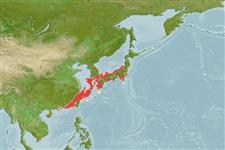
Northwest Pacific: Japan, Korea, China, and Taiwan (Ref. 244). May also occur in the Philippines (Ref.58048). Collected less than a degree west of the northwestern boundary of the Western Central Pacific (Ref. 11146); may consist of a species complex in the area (Ref. 47737).
Lunghezza alla prima maturità / Dimensione / Peso / Età
Maturità: Lm ?, range 40 - ? cm
Max length : 49.0 cm TL maschio/sesso non determinato; (Ref. 244)
Found on the continental shelf; sublittoral zone above 100 m (Ref. 11230). Oviparous, but with several egg-capsules retained in the oviduct until the embryos reach an advanced stage before they are laid which might be regarded as being intermediate between oviparity and ovoviviparity. Diet unknown, but presumably dominated by small invertebrates and fishes. Caught irregularly by demersal longline fisheries operating offshore. Utilized for its meat but of limited value due to its small size (Ref.58048).
Ciclo vitale e comportamento di accoppiamento
Maturità | Riproduzione | Deposizione | Uova | Fecondità | Larve
Oviparous, females depositing between 6-12 oval-shaped egg cases (Ref.58048). Eggs are kept in the oviduct until ready to be hatched. Reproductive strategy lies midway between oviparity and ovoviviparity. Species however, is classified as oviparous.
Compagno, L.J.V., 1984. FAO Species Catalogue. Vol. 4. Sharks of the world. An annotated and illustrated catalogue of shark species known to date. Part 2 - Carcharhiniformes. FAO Fish. Synop. 125(4/2):251-655. Rome: FAO. (Ref. 244)
Stato della Lista Rossa IUCN (Ref. 130435: Version 2025-2 (Global))
Minaccia per l'uomo
Harmless
Usi umani
Pesca: di nessun interesse
Strumenti
Rapporti speciali
Scarica XML
Fonti Internet
Stime basate su modelli
Temperatura preferita (Fonte Biblio.
123201): 15.6 - 21.8, mean 17.9 °C (based on 20 cells).
Indice di diversità filogenetica (Fonte Biblio.
82804): PD
50 = 0.5078 [Uniqueness, from 0.5 = low to 2.0 = high].
Bayesian length-weight: a=0.00347 (0.00172 - 0.00698), b=3.08 (2.90 - 3.26), in cm total length, based on LWR estimates for this (Sub)family-body shape (Ref.
93245).
Livello trofico (Fonte Biblio.
69278): 4.3 ±0.5 se; based on size and trophs of closest relatives
Resilienza (Fonte Biblio.
120179): Basso, tempo minimo di raddoppiamento della popolazione 4.5 - 14 anni (Fec assumed to be <100).
Vulnerabilità della pesca (Ref.
59153): Moderate vulnerability (39 of 100).
🛈