>
Eupercaria/misc (Various families in series Eupercaria) >
Sparidae (Porgies)
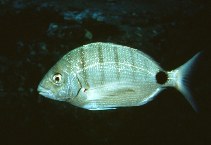
Etymology: Diplodus: Greek, diploos = twice + Greek, odous = teeth (Ref. 45335).
Eponymy: Dr Jean Cadenat (1908–1992) of the University of Dakar, was a French researcher and ichthyologist at the ‘Office de la recherche scientifique et technique outre-mer’, where he was Director of the Marine Biological Section of the Institute Français [...] (Ref. 128868), visit book page.
Environnement : milieu / zone climatique / profondeur / gamme de distribution
Écologie
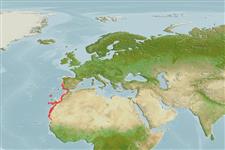
marin récifal. Subtropical; 48°N - 15°N, 18°W - 5°W
Eastern Atlantic: from Senegal north to Madeira, Azores and Bay of Biscay.
Longueur à la première maturité / Taille / Poids / Âge
Maturité: Lm 21.6 range ? - ? cm
Max length : 45.0 cm TL mâle / non sexé; (Ref. 2715); common length : 25.0 cm TL mâle / non sexé; (Ref. 2715); âge max. reporté: 12 années (Ref. 51001)
Forms schools. Inhabits rocky bottoms down to depths of about 150 m, but especially abundant in the surf zone; young occur in Zostera seagrass beds. Prefers to feed on small crustaceans and mollusks; also takes seaweeds and corals (Ref. 3688).
Cycle de vie et comportement reproducteur
Maturité | Reproduction | Frai | Œufs | Fécondité | Larves
Characterized as being a digynic hermaphrodite with partial protandry (Ref. 51001).
Fricke, R., D. Golani and B. Appelbaum-Golani, 2016. Diplodus levantinus (Teleostei: Sparidae), a new species of sea bream from the southeastern Mediterranean Sea of Israel, with a checklist and a key to the species of the Diplodus sargus species group. Scientia Marina 80(3):1-16. (Ref. 110175)
Statut dans la liste rouge de l'IUCN (Ref. 130435: Version 2025-2 (Global))
Menace pour l'homme
Harmless
Utilisations par l'homme
Pêcheries: commercial
Outils
Articles particuliers
Télécharger en XML
Sources Internet
Estimations basées sur des modèles
Indice de diversité phylogénétique (Réf.
82804): PD
50 = 0.5000 [Uniqueness, from 0.5 = low to 2.0 = high].
Bayesian length-weight: a=0.01585 (0.00960 - 0.02616), b=2.94 (2.80 - 3.08), in cm total length, based on LWR estimates for this species & (Sub)family-body (Ref.
93245).
Niveau trophique (Réf.
69278): 3.1 ±0.45 se; based on food items.
Generation time: 7.5 ( na - na) years. Estimated as median ln(3)/K based on 2
growth studies.
Résilience (Réf.
120179): Faible, temps minimum de doublement de population : 4,5 à 14 années (tmax=12).
Vulnérabilité de la pêche (Ref.
59153): Moderate vulnerability (37 of 100).
🛈