>
Scombriformes (Mackerels) >
Nomeidae (Driftfishes)
Etymology: Cubiceps: Latin, cubus = cube + Latin, ceps = head (Ref. 45335).
Eponymy: Thomas Whitelegge (1850–1927) was an English naturalist who emigrated (1883) to Sydney, Australia, where he joined the Linnean Society of New South Wales. [...] (Ref. 128868), visit book page.
More on author: Waite.
Environnement : milieu / zone climatique / profondeur / gamme de distribution
Écologie
marin benthopélagique; profondeur 180 - 550 m (Ref. 9834), usually 300 - 450 m (Ref. 9834). Tropical
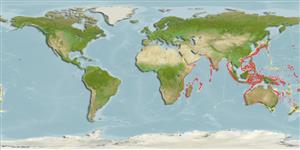
Indo-West Pacific: probably widely distribtuted in tropical and warm-temperate waters of the Indian Ocean (excluding the Red Sea) and from Japan to eastern Australia.
Taille / Poids / Âge
Maturité: Lm ? range ? - ? cm
Max length : 21.0 cm SL mâle / non sexé; (Ref. 54802); common length : 15.0 cm SL mâle / non sexé; (Ref. 9834); poids max. publié: 110.00 g (Ref. 54802)
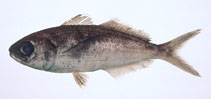
Épines dorsales (Total) : 11 - 13; Rayons mous dorsaux (Total) : 17 - 21; Épines anales: 2 - 3; Rayons mous anaux: 17 - 20; Vertèbres: 31 - 32. Light to dark brown, fins dark; eye blue; young with dark band near base of tail (Ref. 4412). Body moderately elongate and compressed. Ventral profile very convex. Caudal peduncle moderately deep, compressed, lacking scutes or keels. Snout blunt, forehead slightly arched. Mouth small, terminal or slightly inferior, barely reaching beyond anterior margin of eye. Upper jaw not protractile, almost totally covered by lacrimal (preorbital) bone when mouth closed. Eye large , its diameter subequal to snout length, slightly smaller than interorbit, centered on upper half of head. Low ridge extending over eye. Jaw teeth small, in a single series. Palatine teeth more elongate, in single row. Vomerine tooth patch small. Single median row of teeth on tongue (Ref 9834).
Body shape (shape guide): fusiform / normal.
Found near continental and insular margins (Ref. 9834), in deep water on continental slopes (Ref. 30573). Adults are characterized by a demersal mode of life in the upper continental slope, between 180 and 800 m (commonly 300-450 m) and the young are found in mid-water layers (Ref. 54802). Feeds mainly on salps (Ref. 33689). Marketed fresh and could also be used as fishmeal or paste (Ref. 9502).
Cycle de vie et comportement reproducteur
Maturité | Reproduction | Frai | Œufs | Fécondité | Larves
Haedrich, R.L., 1986. Nomeidae. p. 846-850. In M.M. Smith and P.C. Heemstra (eds.) Smiths' sea fishes. Springer-Verlag, Berlin. (Ref. 4412)
Statut dans la liste rouge de l'IUCN (Ref. 130435: Version 2025-2 (Global))
Menace pour l'homme
Harmless
Utilisations par l'homme
Pêcheries: d'intérêt potentiel
Outils
Articles particuliers
Télécharger en XML
Sources Internet
Estimations basées sur des modèles
Température préférée (Réf.
123201): 8.8 - 15.4, mean 11.1 °C (based on 249 cells).
Indice de diversité phylogénétique (Réf.
82804): PD
50 = 0.5010 [Uniqueness, from 0.5 = low to 2.0 = high].
Bayesian length-weight: a=0.00977 (0.00418 - 0.02283), b=3.09 (2.88 - 3.30), in cm total length, based on LWR estimates for this (Sub)family-body shape (Ref.
93245).
Niveau trophique (Réf.
69278): 3.5 ±0.0 se; based on diet studies.
Résilience (Réf.
120179): Haut, temps minimum de doublement de population inférieur à 15 mois (Preliminary K or Fecundity.).
Vulnérabilité de la pêche (Ref.
59153): Low vulnerability (16 of 100).
🛈