>
Ovalentaria/misc (Various families in series Ovalentaria) >
Pomacentridae (Damselfishes) > Pomacentrinae
Etymology: Amphiprion: Greek, amphi = on both sides + Greek, prion, -onos = saw (Ref. 45335).
More on author: Bleeker.
Environnement : milieu / zone climatique / profondeur / gamme de distribution
Écologie
marin récifal; non migrateur; profondeur 3 - 25 m (Ref. 9710). Tropical; 23°N - 35°S
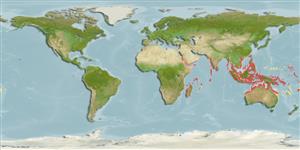
Indo-West Pacific: East Africa, Madagascar, Comoro Islands, Seychelles, Andaman Sea, Sumatra and the Seribu Islands (Java Sea). Not found in Maldives and Sri Lanka (Ref. 4391).
Taille / Poids / Âge
Maturité: Lm ? range ? - ? cm
Max length : 11.0 cm SL mâle / non sexé; (Ref. 5911)
Description synthétique
Clés d'identification | Morphologie | Morphométrie
Épines dorsales (Total) : 8 - 9; Rayons mous dorsaux (Total) : 17 - 20; Épines anales: 2; Rayons mous anaux: 12 - 14.
Body shape (shape guide): fusiform / normal; Cross section: compressed.
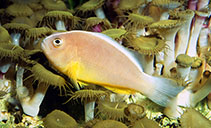
Found in shallow inshore reef habitats, often in strong current zones to about 15 m depth (Ref. 48636). Are protandrous hermaphrodites (Ref. 55367). Each pair is monogamous (Ref. 55367). Each anemone with a large female, a smaller functional male and several stunted juveniles; with the removal of the female, the male changes sex and the largest of the juveniles develops into a functional male (Ref. 4391). Oviparous, distinct pairing during breeding (Ref. 205). Eggs are demersal and adhere to the substrate (Ref. 205). Males guard and aerate the eggs (Ref. 205). Associated with the anemones: Heteractis magnifica, and Stichodactyla mertensii (Ref. 5911). May be reared in captivity (Ref. 35420).
Cycle de vie et comportement reproducteur
Maturité | Reproduction | Frai | Œufs | Fécondité | Larves
Benthic spawner. Sex reversal is completed in less than 63 days (Ref. 34185). Length at sex change = 7.2 cm TL (Ref. 55367). Oviparous, distinct pairing during breeding (Ref. 205). Eggs are demersal and adhere to the substrate (Ref. 205). Males guard and aerate the eggs (Ref. 205). Also Ref. 7471.
Allen, G.R., 1986. Pomacentridae. p. 670-682. In M.M. Smith and P.C. Heemstra (eds.) Smiths' sea fishes. Springer-Verlag, Berlin. (Ref. 4391)
Statut dans la liste rouge de l'IUCN (Ref. 130435: Version 2025-2 (Global))
Menace pour l'homme
Harmless
Utilisations par l'homme
Pêcheries: sans intérêt; Aquarium: Commercial
Outils
Articles particuliers
Télécharger en XML
Sources Internet
Estimations basées sur des modèles
Température préférée (Réf.
123201): 25.6 - 29.3, mean 28.6 °C (based on 2542 cells).
Indice de diversité phylogénétique (Réf.
82804): PD
50 = 0.5000 [Uniqueness, from 0.5 = low to 2.0 = high].
Bayesian length-weight: a=0.01445 (0.00624 - 0.03346), b=3.00 (2.81 - 3.19), in cm total length, based on LWR estimates for this (Sub)family-body shape (Ref.
93245).
Niveau trophique (Réf.
69278): 2.7 ±0.31 se; based on food items.
Résilience (Réf.
120179): Haut, temps minimum de doublement de population inférieur à 15 mois (Preliminary K or Fecundity.).
Vulnérabilité de la pêche (Ref.
59153): Low vulnerability (10 of 100).
🛈
Nutriments (Ref.
124155): Calcium = 111 [62, 177] mg/100g; Iron = 0.785 [0.498, 1.219] mg/100g; Protein = 18.6 [17.5, 19.6] %; Omega3 = 0.146 [0.094, 0.224] g/100g; Selenium = 21.5 [12.8, 38.2] μg/100g; VitaminA = 143 [49, 416] μg/100g; Zinc = 2.07 [1.45, 2.84] mg/100g (wet weight);