>
Gonorynchiformes (Milkfishes) >
Chanidae (Milkfish)
Etymology: Chanos: Greek, chanos, -eos, ous, and chasma, -atos = abyss, mouth opened, inmensity (Ref. 45335).
Umwelt: Milieu / Klimazone / Tiefenbereich / Verbreitungsgebiet
Ökologie
seewasser; süßwasser; brackwasser benthopelagisch; amphidrom (Ref. 9814); tiefenbereich 1 - 30 m (Ref. 6898), usually ? - 15 m (Ref. 89972). Tropical; 15°C - 43°C (Ref. 43081); 46°N - 52°S, 19°E - 77°W
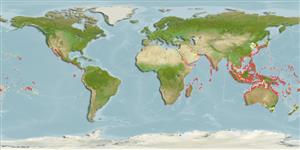
Indo-West Pacific: South Africa to Red Sea, to Hawaii and the Marquesas, north to Japan, south to Victoria, Australia. Eastern Pacific: San Pedro, California to the Galapagos.
Länge bei der ersten Reifung / Größe / Gewicht / Alter
Geschlechtsreife: Lm 86.1, range 68 - 70 cm
Max length : 180 cm SL Männchen/unbestimmt; (Ref. 9710); 124.0 cm SL (female); common length : 100.0 cm SL Männchen/unbestimmt; (Ref. 9814); max. veröff. Gewicht: 14.0 kg (Ref. 9814); max. veröff. Alter: 15 Jahre (Ref. 9814)
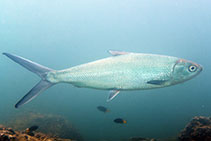
Rückenflossenstacheln (insgesamt) : 2; Rückenflossenweichstrahlen (insgesamt) : 13 - 17; Afterflossenstacheln: 2; Afterflossenweichstrahlen: 8 - 10; Wirbelzahl: 46. This species is characterized by the following: body elongate and somewhat compressed; mouth small and toothless; single dorsal about mid-level of the body; pectoral fins falcate; caudal fin large and deeply forked; no scutes on belly; branchiostegal rays 4. Colour of the body olive green dorsally; flanks silvery; unpaired fins with dark margins (Ref. 49, 117228).
Body shape (shape guide): elongated; Cross section: oval.
Adults are found in offshore marine waters and shallow coastal embayments, but also frequently enter estuaries and occasionally penetrate freshwater streams, along continental shelves and around islands, where temperatures are greater than 20°C. (Ref. 44894, 52331). They occur in small to large schools near the coasts or around islands where reefs are well developed. Eggs and larvae are pelagic up to 2-3 weeks. Older larvae migrate onshore and settle in coastal wetlands (mangroves, estuaries) during the juvenile stage, or occasionally enter freshwater lakes. Juveniles and sub-adults return to sea where they mature sexually. Mature adults spawn only in fully saline water. Larvae eat zooplankton; juveniles and adults eat cyanobacteria, soft algae, small benthic invertebrates, and even pelagic fish eggs and larvae. Larvae are collected from rivers and are grown in culture ponds into juveniles which are marketed fresh, smoked, canned or frozen. Brood stocks can be raised and spawned in captivity to produce larvae in the hatchery (Ref. 12868). This species can thrive and grow in water as hot as 32° C (Ref. 9987).
Spawns in clear shallow waters above a bottom of sand or coral and at a distance of not more than 30 km from the shore. Females spawn up to 5 million eggs which hatch in about 24 hr. The larvae seek out clear coastal and estuarine waters warmer than 23°C with 10-32 salinity and abundant phytoplankton. Spawning and fertilization take place at night.
Bagarinao, T., 1994. Systematics, distribution, genetics and life history of milkfish, Chanos chanos. Environ. Biol. Fishes 39(1):23-41. (Ref. 9814)
IUCN Rote Liste Status (Ref. 130435: Version 2025-2 (Global))
Bedrohung für Menschen
Harmless
Nutzung durch Menschen
Fischereien: hoch kommerziell; Aquakultur: kommerziell; Sportfisch: ja; Köder: usually
Tools
Zusatzinformationen
Download XML
Internet Quellen
Schätzungen auf der Grundlage von Modellen
Bevorzugte Temperatur (Ref.
123201): 20.7 - 29.2, mean 28.2 °C (based on 4182 cells).
Phylogenetischer Diversitätsindex (Ref.
82804): PD
50 = 1.5000 [Uniqueness, from 0.5 = low to 2.0 = high].
Bayesian length-weight: a=0.00851 (0.00649 - 0.01116), b=3.06 (2.98 - 3.14), in cm total length, based on LWR estimates for this species (Ref.
93245).
Trophische Ebene (Ref.
69278): 2.5 ±0.14 se; based on food items.
Widerstandsfähigkeit (Ref.
120179): niedrig, Verdopplung der Population dauert 4,5 - 14 Jahre. (tm=4-8; tmax=15; Fec=200,000).
Prior r = 0.28, 95% CL = 0.19 - 0.42, Based on 3 data-limited stock assessments.
Anfälligkeit der Fischerei (Ref.
59153): Very high vulnerability (90 of 100).
🛈
Klimaanfälligkeit (Ref.
125649): High to very high vulnerability (66 of 100).
🛈
Nährstoffe (Ref.
124155): Calcium = 46.4 [25.2, 89.0] mg/100g; Iron = 0.661 [0.361, 1.169] mg/100g; Protein = 19.8 [15.5, 22.5] %; Omega3 = 0.111 [0.053, 0.225] g/100g; Selenium = 87.2 [39.4, 201.1] μg/100g; VitaminA = 11.4 [3.5, 34.1] μg/100g; Zinc = 1.39 [0.95, 2.06] mg/100g (wet weight); based on
nutrient studies.