Elasmobranquios (tiburones y rayas) (sharks and rays) >
Rhinopristiformes (Shovelnose rays) >
Rhinobatidae (Guitarfishes)
Etymology: Rhinobatos: Greek, rhinos = nose + Greek, batis, -idos = a ray (Raja sp.) (Ref. 45335).
Eponymy: Hermann Schlegel (1804–1884) was a German-born zoologist who spent much of his life in the Netherlands. [...] (Ref. 128868), visit book page.
More on authors: Müller & Henle.
Entorno: milieu / zona climática / rango de profundidad / gama de distribución
Ecología
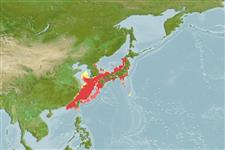
marino demersal; rango de profundidad ? - 200 m (Ref. 30573). Subtropical; 42°N - 21°N, 117°E - 143°E (Ref. 114953)
Northwest Pacific: Japan to Taiwan, reports from Philippines and India probably appear to be other species (Ref. 114953).
Tamaño / Peso / Edad
Madurez: Lm ? range ? - ? cm
Max length : 100.0 cm TL macho / no sexado; (Ref. 637)
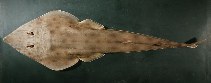
Found near shore on sandy-mud bottoms (Ref. 11230, 30573). Reported to occur offshore (Ref. 58784). Feeds on small benthic animals. Ovoviviparous (Ref. 50449). Males mature at ca. 55 cm TL. Produces litters of 1-14 pups (Ref. 114953). The best edible fish in the family, served in raw slices or hard boiled with seasonings (Ref. 637). Dried fins used for shark-fin soup (Ref. 30573).
Ciclo vital y comportamiento de apareamiento
Madurez | Reproducción | Puesta | Huevos | Fecundidad | Larva
Exhibit ovoviparity (aplacental viviparity), with embryos feeding initially on yolk, then receiving additional nourishment from the mother by indirect absorption of uterine fluid enriched with mucus, fat or protein through specialised structures (Ref. 50449).
Compagno, L.J.V., 1999. Checklist of living elasmobranchs. p. 471-498. In W.C. Hamlett (ed.) Sharks, skates, and rays: the biology of elasmobranch fishes. Johns Hopkins University Press, Maryland. (Ref. 35766)
Situación en la Lista Roja de la UICN (Ref. 130435: Version 2025-2 (Global))
Amenaza para el ser humano
Harmless
Usos humanos
Pesquerías: comercial
Herramientas
Informes especiales
Descargar XML
Fuentes de Internet
Estimaciones basadas en modelos
Temperatura preferida (Referencia
123201): 14.4 - 27.1, mean 23.6 °C (based on 475 cells).
Índice de diversidad filogenética (Referencia
82804): PD
50 = 0.5000 [Uniqueness, from 0.5 = low to 2.0 = high].
Bayesian length-weight: a=0.00295 (0.00150 - 0.00581), b=3.13 (2.96 - 3.30), in cm total length, based on LWR estimates for this (Sub)family-body shape (Ref.
93245).
Nivel trófico (Referencia
69278): 3.5 ±0.37 se; based on food items.
Resiliencia (Referencia
120179): Muy bajo, población duplicada en un tiempo mínimo superior a 14 años (Fec=6).
Vulnerabilidad pesquera (Ref.
59153): High vulnerability (60 of 100).
🛈