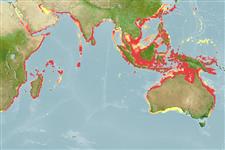
Ambiente: milieu / zona climatica / distribuzione batimetrica / gamma di distribuzione
Ecologia
marino; acqua dolce; salmastro demersale; distribuzione batimetrica 5 - 70 m (Ref. 114953). Tropical; 30°N - 37°S, 20°E - 155°E (Ref. 114953)
Indo-West Pacific: Persian Gulf (Ref. 68964), Red Sea and east to South Africa, western India Sri Lanka, Laos to Papua New Guinea, south to New South Wales, western to eastern Australia (Ref. 114953).
Lunghezza alla prima maturità / Dimensione / Peso / Età
Maturità: Lm ?, range 430 - ? cm
Max length : 730 cm TL maschio/sesso non determinato; (Ref. 5578); common length : 550 cm TL maschio/sesso non determinato; (Ref. 11228)
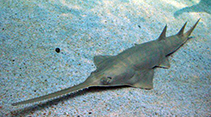
Dark grey to blackish brown above, white to yellowish below (Ref. 11228).
Body shape (shape guide): elongated.
Demersal on both insular and continental shelves, but now thought to be extinct through much if its original range (Ref. 114953). Inshore and intertidal species known to enter freshwater in some areas (Ref. 9859). Found in shallow bays, estuaries, and lagoons (Ref. 11228). Often on the bottom with its saw elevated at an angle to the body axis (Ref. 9859). Feeds on fishes and shellfishes (Ref. 58784). Ovoviviparous (Ref. 50449). Reaches maturity after 9 years. Females have litters of approximately 12 pups. Maturity size unclear, possibly near 430 cm TL; born at approximately 80 cm TL (Ref. 114953). Flesh considered tasty (Ref. 11228).
Ciclo vitale e comportamento di accoppiamento
Maturità | Riproduzione | Deposizione | Uova | Fecondità | Larve
Ovoviviparous, embryos feed solely on yolk (Ref. 50449).
Compagno, L.J.V. and P.R. Last, 1999. Pristidae. Sawfishes. p. 1410-1417. In K.E. Carpenter and V. Niem (eds.) FAO identification guide for fishery purposes. The Living Marine Resources of the Western Central Pacific Vol. 3. FAO, Rome. (Ref. 9859)
Stato della Lista Rossa IUCN (Ref. 130435: Version 2025-2 (Global))
Minaccia per l'uomo
Traumatogenic (Ref. 9859)
Usi umani
Pesca: commerciale; Pesce da pesca sportiva: si
Strumenti
Rapporti speciali
Scarica XML
Fonti Internet
Stime basate su modelli
Temperatura preferita (Fonte Biblio.
123201): 24.6 - 29.3, mean 28.5 °C (based on 2833 cells).
Indice di diversità filogenetica (Fonte Biblio.
82804): PD
50 = 0.5234 [Uniqueness, from 0.5 = low to 2.0 = high].
Bayesian length-weight: a=0.00501 (0.00199 - 0.01264), b=3.05 (2.82 - 3.28), in cm total length, based on LWR estimates for this (Sub)family-body shape (Ref.
93245).
Livello trofico (Fonte Biblio.
69278): 4.0 ±0.6 se; based on size and trophs of closest relatives
Resilienza (Fonte Biblio.
120179): Basso, tempo minimo di raddoppiamento della popolazione 4.5 - 14 anni (Fec assumed to be <100).
Vulnerabilità della pesca (Ref.
59153): Very high vulnerability (90 of 100).
🛈
Nutrienti (Ref.
124155): Calcium = 12.4 [3.1, 55.8] mg/100g; Iron = 0.505 [0.120, 1.454] mg/100g; Protein = 19.3 [17.2, 21.4] %; Omega3 = 0.11 [0.04, 0.28] g/100g; Selenium = 81.8 [22.3, 265.0] μg/100g; VitaminA = 3.88 [1.41, 10.36] μg/100g; Zinc = 0.61 [0.29, 1.12] mg/100g (wet weight);