Taxonomic Remarks
Sphyraena nigripinnis Temminck & Schlegel, 1843 considered as valid in CofF (ref. 118474).
Entorno: milieu / zona climática / rango de profundidad / gama de distribución
Ecología
marino asociado a arrecife; rango de profundidad 0 - 100 m (Ref. 89972). Tropical; 30°N - 24°S
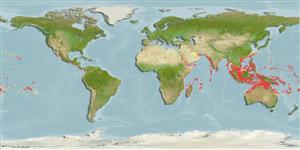
Indo-Pacific: East Africa, Red Sea to Persian Gulf (Ref.80050), to the central Indian Ocean and French Polynesia. Eastern Pacific: Mexico and Panama. The exact range is uncertain because of confusion with Sphyraena jello and Sphyraena putnamae (Ref. 9768).
Tamaño / Peso / Edad
Madurez: Lm ? range ? - ? cm
Max length : 170 cm TL macho / no sexado; (Ref. 9710); common length : 80.0 cm TL macho / no sexado; (Ref. 9768); peso máximo publicado: 7.1 kg (Ref. 40637)
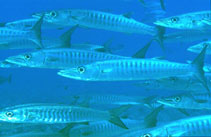
Espinas dorsales (total) : 6; Radios blandos dorsales (total) : 9; Espinas anales: 2; Radios blandos anales: 7 - 9. Many dark bars crossing lateral line on body, each bar oblique in upper half, but nearly vertical in the lower; caudal fin largely blackish. No gill rakers on first arch; upper and lower gill arch with rough platelets, each platelet not bearing distinct spine.
Body shape (shape guide): elongated; Cross section: oval.
Found near current-swept lagoon and seaward reefs (Ref. 9710). Feeds on fishes (Ref. 89972). Usually seen in large semi-stationary schools during the day (Ref. 9768) which have a tendency to occupy the same site for months or even years at a time. Probably disperses at night to feed (Ref. 1602). Often hooked by trolling between dusk and dawn (Ref. 37816). Minimum depth reported taken from Ref. 128797.
Ciclo vital y comportamiento de apareamiento
Madurez | Reproducción | Puesta | Huevos | Fecundidad | Larva
In general, barracudas in large numbers aggegate during spawning season and migrate to specific spawning areas (Ref. 240).
De Sylva, D.P. and F. Williams, 1986. Sphyraenidae. p. 721-726. In M.M. Smith and P.C. Heemstra (eds.) Smiths' sea fishes. Springer-Verlag, Berlin. (Ref. 5491)
Situación en la Lista Roja de la UICN (Ref. 130435: Version 2025-2 (Global))
Amenaza para el ser humano
Reports of ciguatera poisoning (Ref. 4537)
Usos humanos
Pesquerías: comercial; pesca deportiva: si
Herramientas
Informes especiales
Descargar XML
Fuentes de Internet
Estimaciones basadas en modelos
Temperatura preferida (Referencia
123201): 26.1 - 29, mean 28.1 °C (based on 1626 cells).
Índice de diversidad filogenética (Referencia
82804): PD
50 = 0.5000 [Uniqueness, from 0.5 = low to 2.0 = high].
Bayesian length-weight: a=0.00708 (0.00326 - 0.01539), b=2.92 (2.74 - 3.10), in cm total length, based on LWR estimates for this Genus-body shape (Ref.
93245).
Nivel trófico (Referencia
69278): 4.5 ±0.80 se; based on food items.
Resiliencia (Referencia
120179): Muy bajo, población duplicada en un tiempo mínimo superior a 14 años (Preliminary K or Fecundity.).
Vulnerabilidad pesquera (Ref.
59153): Very high vulnerability (90 of 100).
🛈
Nutrientes (Ref.
124155): Calcium = 9.8 [4.8, 25.1] mg/100g; Iron = 0.241 [0.113, 0.501] mg/100g; Protein = 20.2 [18.2, 21.9] %; Omega3 = 0.0769 [, ] g/100g; Selenium = 47 [19, 118] μg/100g; VitaminA = 33 [7, 160] μg/100g; Zinc = 0.4 [0.3, 0.7] mg/100g (wet weight);