Elasmobranchii (haaien en roggen) (sharks and rays) >
Carcharhiniformes (Ground sharks) >
Atelomycteridae (Coloured catsharks)
Etymology: Atelomycterus: ateles (Gr.), imperfect, unfilled or exempt; mycteros (Gr.), nostril, referring to lack of posterior nasal valve (See ETYFish); macleayi: Patronym not identified, probably in honor of William Macleay (1820-1891), Scottish-Australian politician and naturalist, who published many papers on the fihes of Australia (See ETYFish).
Eponymy: Sir William John Macleay (1820–1891) was a Scottish medical student who followed his uncle Alexander to Sidney (1838), where he became an all-round naturalist. [...] (Ref. 128868), visit book page.
More on author: Whitley.
Milieu: milieu / Klimaatzone / Diepte / verspreidingsgebied
Ecologie
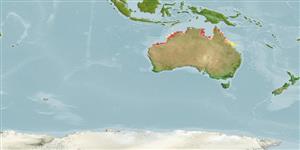
marien rifbewoner; diepte 0 - 4 m (Ref. 244). Tropical; 12°S - 21°S
Eastern Indian Ocean: endemic to Australia.
Lengte bij maturiteit / Grootte / Gewicht / Leeftijd
Maturiteit: Lm ?, range 51 - ? cm
Max length : 60.0 cm TL mannelijk / geslacht onbekend; (Ref. 244)
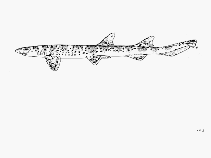
Dorsale stekels (totaal) : 0; Anale stekels: 0. Color pattern of grey saddles separated by light areas and outlined by numerous small black spots (hatchlings have a simpler pattern of dark saddles, remarkably similar to Acanthophthalmus semicinctus) (Ref. 11146).
Body shape (shape guide): elongated.
A little-known inshore catshark found on sandy and rocky bottom (Ref. 11146). Oviparous (Ref. 50449). Hatching length around 10 cm (Ref. 6871).
Levenscyclus en paargedrag
Maturiteit | Voortplanting | Paaien | Eieren | Fecunditeit | Larven
Oviparous, paired eggs are laid. Embryos feed solely on yolk (Ref. 50449). Hatches at about 10 cm (Ref. 6871).
Compagno, L.J.V., 1984. FAO Species Catalogue. Vol. 4. Sharks of the world. An annotated and illustrated catalogue of shark species known to date. Part 2 - Carcharhiniformes. FAO Fish. Synop. 125(4/2):251-655. Rome: FAO. (Ref. 244)
Status op de Rode Lijst van het IUCN (Ref. 130435: Version 2025-2 (Global))
Gebruik door de mens
Visserij: van minder commercieel belang
Tools
Speciale rapporten
Download XML
Internetbronnen
Schattingen op basis van modellen
Gewenste temperatuur (Ref.
123201): 26 - 28.8, mean 27.8 °C (based on 172 cells).
Fylogenetische diversiteitsindex (Ref.
82804): PD
50 = 0.5157 [Uniqueness, from 0.5 = low to 2.0 = high].
Bayesian length-weight: a=0.00389 (0.00180 - 0.00842), b=3.12 (2.94 - 3.30), in cm total length, based on all LWR estimates for this body shape (Ref.
93245).
Trofisch niveau (Ref.
69278): 3.7 ±0.3 se; based on size and trophs of closest relatives
Weerstandsvermogen (Ref.
120179): laag, minimale populatieverdubbelingstijd 4,5-14 jaar (Fec assumed to be <100).
Kwetsbaarheid van de visserij (Ref.
59153): Moderate vulnerability (44 of 100).
🛈