Umwelt: Milieu / Klimazone / Tiefenbereich / Verbreitungsgebiet
Ökologie
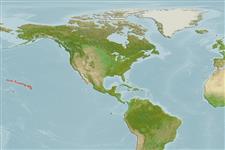
seewasser riff-verbunden; tiefenbereich 1 - 217 m (Ref. 58302). Tropical; 27°N - 16°N, 175°W - 154°W
Eastern Central Pacific: known only from the Hawaiian Islands and Johnston Atoll.
Größe / Gewicht / Alter
Geschlechtsreife: Lm ? range ? - ? cm
Max length : 17.0 cm TL Männchen/unbestimmt; (Ref. 9710); common length : 14.0 cm TL Männchen/unbestimmt; (Ref. 583)
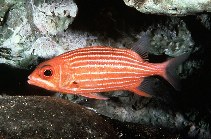
Rückenflossenstacheln (insgesamt) : 11; Rückenflossenweichstrahlen (insgesamt) : 13 - 14; Afterflossenstacheln: 4; Afterflossenweichstrahlen: 9. Body with alternating about stripes of red and silvery white; head red; operculum with silvery reflections, a white streak from above edge of upper jaw to the corner of pre, and a narrow white band on posterior edge of preopercle. Five oblique scale rows on cheek; body depth 2.7-3.1 in SL; head length (HL) 2.55-2.75 in SL; snout length 3.85-4.15 in HL; interorbital width 4.8-5.15 in HL; maxilla extending from below front of the pupil nearly to center of the eye, upper jaw length 2.55-2.8 in HL; premaxillary groove at least to a vertical at front edge of the orbit; rounded anterior end of nasal; medial margin of nasal bone spineless; small nasal fossa without spinules on margin; slight ridge along the upper edge of suborbital bones smooth anteriorly, slightly serrate below posterior part of eye; preopercular spine, 5.4-7.1 in HL; 2 opercular spines (1 specimen with a large opercular spine), the lower 1/2 to 2/3 length of the upper spine; 4th dorsal spine usually longest, 2.2-2.55 in HL; 3rd anal spine 1.5-2.05 in HL (Ref. 27370).
Body shape (shape guide): fusiform / normal; Cross section: oval.
Inhabits seaward reefs below the surge zone, common near caves and ledges (Ref. 9710). Feeds mainly on crustaceans.
Lebenszyklus und Paarungsverhalten
Geschlechtsreife | Fortpflanzung | Ablaichen | Eier | Fruchtbarkeit | Larven
Randall, J.E., 1998. Revision of the Indo-Pacific squirrelfishes (Beryciformes: Holocentridae: Holocentrinae) of the genus Sargocentron, with descriptions of four new species. Indo-Pac. Fish. (27):105 p. (Ref. 27370)
IUCN Rote Liste Status (Ref. 130435: Version 2025-2 (Global))
Bedrohung für Menschen
Harmless
Nutzung durch Menschen
Fischereien: kommerziell; Aquarium: Kommerziell
Tools
Zusatzinformationen
Download XML
Internet Quellen
Schätzungen auf der Grundlage von Modellen
Bevorzugte Temperatur (Ref.
123201): 6.1 - 13.9, mean 8.7 °C (based on 5 cells).
Phylogenetischer Diversitätsindex (Ref.
82804): PD
50 = 0.5000 [Uniqueness, from 0.5 = low to 2.0 = high].
Bayesian length-weight: a=0.01698 (0.00810 - 0.03560), b=2.96 (2.79 - 3.13), in cm total length, based on LWR estimates for this Genus-body shape (Ref.
93245).
Trophische Ebene (Ref.
69278): 3.5 ±0.3 se; based on diet studies.
Widerstandsfähigkeit (Ref.
120179): hoch, Verdopplung der Population dauert weniger als 15 Monate. (Preliminary K or Fecundity.).
Anfälligkeit der Fischerei (Ref.
59153): Low vulnerability (10 of 100).
🛈
Nährstoffe (Ref.
124155): Calcium = 69.1 [27.1, 290.0] mg/100g; Iron = 0.59 [0.24, 1.82] mg/100g; Protein = 18.4 [17.2, 19.6] %; Omega3 = 0.182 [0.077, 0.420] g/100g; Selenium = 45.5 [25.6, 86.1] μg/100g; VitaminA = 71.7 [27.1, 201.5] μg/100g; Zinc = 2.04 [0.84, 3.79] mg/100g (wet weight);