Klassifizierung / Names
Namen | Synonyme | Catalog of Fishes(Gattung, Arten) | ITIS | CoL | WoRMS | Cloffa
>
Kurtiformes (Nurseryfishes, cardinalfishes.) >
Apogonidae (Cardinalfishes) > Apogoninae
Etymology: Fibramia: Latin 'fibra' meaning thread or filament and the feminine Greek 'amia' often applied as an ending for some cardinalfish genera as well as an incorrect past usage as a cardinalfish genus. The name refers to two characteristics of the species in this genus, an elongate second dorsal spine in one species and the narrow, pale or dark mid-line on the body of two species.
More on author: Bleeker.
Umwelt: Milieu / Klimazone / Tiefenbereich / Verbreitungsgebiet
Ökologie
seewasser; süßwasser; brackwasser riff-verbunden; tiefenbereich 2 - 5 m (Ref. 11890). Tropical; 32°N - 23°S
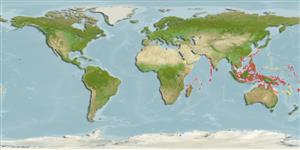
Indo-West Pacific: Zanzibar (Tanzania) eastward to Southeast Asia, and north to Amami-ôshima (Japan) southward to Taiwan, Palau, Philippines and New Guinea east to the Solomon Island and New Caledonia.
Größe / Gewicht / Alter
Geschlechtsreife: Lm ? range ? - ? cm
Max length : 7.0 cm SL Männchen/unbestimmt; (Ref. 7050)
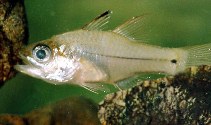
Rückenflossenstacheln (insgesamt) : 7; Rückenflossenweichstrahlen (insgesamt) : 9; Afterflossenstacheln: 2; Afterflossenweichstrahlen: 8. Distinguished by having the following characteristics: dorsal-fin rays VI-I, 9; anal-fin rays II, 8; pectoral-fin rays 14; pelvic-fin rays I, 5; pored lateral-line scales 24; predorsal scales 7; circumpeduncular scales 12; total gill rakers 21-22, developed gill rakers 19-20; light brown body; two black stripes, one from snout to opercular margin through eye, and the second one on anterior portion of lateral line; blackish anterior part of first dorsal fin; base of caudal-fin with distinct black spot (Ref. 93839).
Body shape (shape guide): short and / or deep; Cross section: compressed.
Found in brackish water at river mouths and among the mangroves. Also enters freshwater during low tide. Mouth brooding by males (Ref. 559).
Lebenszyklus und Paarungsverhalten
Geschlechtsreife | Fortpflanzung | Ablaichen | Eier | Fruchtbarkeit | Larven
Mouthbrooders (Ref. 240). Distinct pairing during courtship and spawning (Ref. 205).
Masuda, H., K. Amaoka, C. Araga, T. Uyeno and T. Yoshino, 1984. The fishes of the Japanese Archipelago. Vol. 1. Tokai University Press, Tokyo, Japan. 437 p. (text). (Ref. 559)
IUCN Rote Liste Status (Ref. 130435: Version 2025-2 (Global))
Bedrohung für Menschen
Harmless
Nutzung durch Menschen
Tools
Zusatzinformationen
Download XML
Internet Quellen
Schätzungen auf der Grundlage von Modellen
Bevorzugte Temperatur (Ref.
123201): 25.4 - 29.3, mean 28.7 °C (based on 1895 cells).
Phylogenetischer Diversitätsindex (Ref.
82804): PD
50 = 0.6250 [Uniqueness, from 0.5 = low to 2.0 = high].
Bayesian length-weight: a=0.01514 (0.00700 - 0.03275), b=3.07 (2.89 - 3.25), in cm total length, based on LWR estimates for this (Sub)family-body shape (Ref.
93245).
Trophische Ebene (Ref.
69278): 3.7 ±0.5 se; based on size and trophs of closest relatives
Widerstandsfähigkeit (Ref.
120179): hoch, Verdopplung der Population dauert weniger als 15 Monate. (Preliminary K or Fecundity.).
Anfälligkeit der Fischerei (Ref.
59153): Low vulnerability (10 of 100).
🛈
Nährstoffe (Ref.
124155): Calcium = 197 [96, 370] mg/100g; Iron = 1.1 [0.6, 2.1] mg/100g; Protein = 18.9 [17.7, 20.1] %; Omega3 = 0.123 [0.061, 0.248] g/100g; Selenium = 20.7 [8.7, 45.5] μg/100g; VitaminA = 64.3 [17.4, 241.7] μg/100g; Zinc = 2.44 [1.47, 3.79] mg/100g (wet weight);