>
Tetraodontiformes (Puffers and filefishes) >
Tetraodontidae (Puffers) > Canthigasterinae
Etymology: Canthigaster: Greek, kanthos = the outer or inner corner of the eye, where the lids meet, 1646 + Greek, gaster = stomach (Ref. 45335).
More on authors: Vaillant & Sauvage.
Umwelt: Milieu / Klimazone / Tiefenbereich / Verbreitungsgebiet
Ökologie
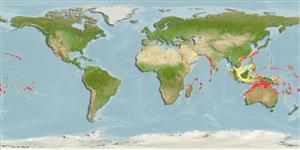
seewasser riff-verbunden; tiefenbereich 6 - 165 m (Ref. 83660). Tropical; 30°N - 30°S
Former distribution of Hawaii and Tonga to the east coast of Africa and the Red Sea, is divided into three species: C. coronata, endemic to the Hawaiian Islands;
C. axiologus ranges from Japan to New South Wales, east to the Marshall Islands and Tonga; and C. cyanospilota from the Indian Ocean and Red Sea (type locality, Gulf of Aqaba) (Ref. 83660).
Größe / Gewicht / Alter
Geschlechtsreife: Lm ? range ? - ? cm
Max length : 11.3 cm SL Männchen/unbestimmt; (Ref. 137577)
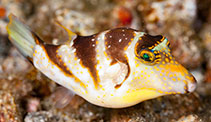
Rückenflossenstacheln (insgesamt) : 0; Rückenflossenweichstrahlen (insgesamt) : 9 - 11; Afterflossenstacheln: 0; Afterflossenweichstrahlen: 9 - 10. This species is characterized by the following: D 9-11 (usually 10, rarely 9); A 9-10 (usually 10); pectoral rays 15-18 (usually 17); gill rakers 7-9; body depth between origins of dorsal and anal fins 2.8-3.25 in SL; head length (HL) 2.3-2.55 in SL; interorbital width 3.9-4.45 in HL; gill opening 3.7-4.75 in HL; anal fin origin below or anterior to rear base of dorsal fin, preanal length 1.35-1.4 in SL; longest dorsal ray 2.2-2.5 in HL; preserved colour pale grey to pale tan with 3 triangular dark brown saddle-like bars dorsally on body, progressively more oblique posteriorly, the first extending narrowly to ventral edge of gill opening, the second to level of lower edge of pectoral-fin base and enclosing base of dorsal fin posteriorly, and the last ending at upper base of caudal fin; a dark brown band run across posterior interorbital and anterior occiput; a dark brown spot below base of pectoral fin; head and body with many small pale spots (most about half pupil diameter), faint or absent on paler parts of body but very evident on edges, within dark bars, and on head where ground colour darker; around eye are narrow pale bands and spots; pale lips encircled with a narrow dusky band; a thin dark brown line midventrally on abdomen and chest present or absent (may be broken to long segments); pale fins, with upper and lower margins of caudal fin with a broad brown band, darker at base; when fresh, noteworthy are the many small yellow spots, and the lack of blue spots - blue only between yellow markings around eye (Ref. 83660).
Body shape (shape guide): short and / or deep; Cross section: angular.
Found mostly below depths of 23 m, but occasionally seen in as little as 6 m (Ref. 3921). Benthopelagic (Ref. 58302). Usually found on sand or sand and rubble bottom or algal flats, often in the vicinity of coral reefs (Ref. 83660). Feed on a wide variety of benthic organisms: gastropods, sponges, algae, bivalves, polychaetes, tunicates, crabs, sea urchins, heart urchins, brittle stars, bryozoans, peanut worms, various small crustaceans and foraminiferans (Ref. 3921).
Lebenszyklus und Paarungsverhalten
Geschlechtsreife | Fortpflanzung | Ablaichen | Eier | Fruchtbarkeit | Larven
Randall, J.E., J.T. Williams and L.A. Rocha, 2008. The Indo-Pacific tetraodontid fish Canthigaster coronata, a complex of three species. Smithiana, Publ. Aquatic Biodiv. Bull. 9:3-13. (Ref. 83660)
IUCN Rote Liste Status (Ref. 130435: Version 2025-2 (Global))
Bedrohung für Menschen
Other
Nutzung durch Menschen
Fischereien: kommerziell; Aquarium: Kommerziell
Tools
Zusatzinformationen
Download XML
Internet Quellen
Schätzungen auf der Grundlage von Modellen
Bevorzugte Temperatur (Ref.
123201): 23.8 - 28.3, mean 26.8 °C (based on 332 cells).
Phylogenetischer Diversitätsindex (Ref.
82804): PD
50 = 0.5000 [Uniqueness, from 0.5 = low to 2.0 = high].
Bayesian length-weight: a=0.03631 (0.01540 - 0.08559), b=2.88 (2.69 - 3.07), in cm total length, based on LWR estimates for this Genus-body shape (Ref.
93245).
Trophische Ebene (Ref.
69278): 3.5 ±0.0 se; based on diet studies.
Widerstandsfähigkeit (Ref.
120179): hoch, Verdopplung der Population dauert weniger als 15 Monate. (Preliminary K or Fecundity.).
Anfälligkeit der Fischerei (Ref.
59153): Low vulnerability (10 of 100).
🛈
Nährstoffe (Ref.
124155): Calcium = 92.1 [40.6, 239.9] mg/100g; Iron = 0.898 [0.444, 2.136] mg/100g; Protein = 18.1 [15.9, 20.4] %; Omega3 = 0.157 [0.076, 0.315] g/100g; Selenium = 43.1 [19.6, 97.4] μg/100g; VitaminA = 61.8 [16.5, 251.5] μg/100g; Zinc = 1.47 [0.93, 2.24] mg/100g (wet weight);