>
Blenniiformes (Blennies) >
Blenniidae (Combtooth blennies) > Blenniinae
Etymology: Plagiotremus: Greek, plagios = oblique + Greek, trema = hole (Ref. 45335); goslinei: Named for Dr. William A. Gosline of the University of Hawaii.
Eponymy: Dr William Alonzo Gosline (1915–2002) was an ichthyologist and botanist at the University of Michigan. [...] (Ref. 128868), visit book page.
Entorno: milieu / zona climática / rango de profundidad / gama de distribución
Ecología
marino asociado a arrecife; rango de profundidad 1 - 15 m (Ref. 58302). Tropical
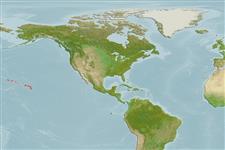
Eastern Central Pacific: Hawaiian Islands.
Tamaño / Peso / Edad
Madurez: Lm ? range ? - ? cm
Max length : 6.4 cm SL macho / no sexado; (Ref. 3921)
Descripción breve
Claves de identificación | Morfología | Morfometría
Espinas dorsales (total) : 11 - 12; Radios blandos dorsales (total) : 23 - 26; Espinas anales: 3; Radios blandos anales: 20 - 21.
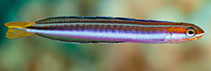
Body shape (shape guide): elongated; Cross section: compressed.
Adults are benthic or benthopelagic in or over coral (Ref. 58302). Common from the shallow waters to about 15 m. Taken with rotenone at 3-5 feet along rocky seashores where there was some sand bottom and where water circulation was good. Some specimens were collected from the stomachs of large fish (e.g. yellowfin tuna, Neothunnus macropterus) and from dolphins (Coryphaena hippurus) (Ref. 643). Oviparous. Eggs are demersal and adhesive (Ref. 205), and are attached to the substrate via a filamentous, adhesive pad or pedestal (Ref. 94114). Larvae are planktonic, often found in shallow, coastal waters (Ref. 94114).
Ciclo vital y comportamiento de apareamiento
Madurez | Reproducción | Puesta | Huevos | Fecundidad | Larva
Oviparous, distinct pairing (Ref. 205).
Randall, J.E., 1985. Guide to Hawaiian reef fishes. Harrowood Books, Newtown Square, PA 19073, USA. 74 p. (Ref. 3921)
Situación en la Lista Roja de la UICN (Ref. 130435: Version 2025-2 (Global))
Amenaza para el ser humano
Harmless
Usos humanos
Pesquerías: comercial; Acuario: Comercial
Herramientas
Informes especiales
Descargar XML
Fuentes de Internet
Estimaciones basadas en modelos
Temperatura preferida (Referencia
123201): 24.8 - 28.4, mean 25.4 °C (based on 36 cells).
Índice de diversidad filogenética (Referencia
82804): PD
50 = 0.5005 [Uniqueness, from 0.5 = low to 2.0 = high].
Bayesian length-weight: a=0.00575 (0.00255 - 0.01297), b=3.06 (2.87 - 3.25), in cm total length, based on LWR estimates for this (Sub)family-body shape (Ref.
93245).
Nivel trófico (Referencia
69278): 4.0 ±0.7 se; based on size and trophs of closest relatives
Resiliencia (Referencia
120179): Alto, población duplicada en un tiempo mínimo inferior a 15 meses (Preliminary K or Fecundity.).
Vulnerabilidad pesquera (Ref.
59153): Low vulnerability (10 of 100).
🛈
Nutrientes (Ref.
124155): Calcium = 183 [92, 342] mg/100g; Iron = 0.968 [0.544, 1.654] mg/100g; Protein = 18.3 [17.2, 19.4] %; Omega3 = 0.108 [0.055, 0.206] g/100g; Selenium = 19.1 [8.7, 45.1] μg/100g; VitaminA = 285 [96, 839] μg/100g; Zinc = 1.95 [1.24, 2.91] mg/100g (wet weight);