Elasmobranquios (tiburones y rayas) (sharks and rays) >
Carcharhiniformes (Ground sharks) >
Pentanchidae (Deepwater catsharks)
Etymology: Apristurus: a-, Latin privative, i.e., without; pristis, from pristes (Gr.), sawyer (but here meaning saw); oura (Gr.), tail, referring to absence of saw-toothed crest of enlarged dermal denticles along upper edge of caudal fin as found in the closely related Pristiurus (=Galeus) (See ETYFish); platyrhynchus: platys (Gr.), wide; rhynchus (L.), snout, referring to its shorter, wider snout compared with A. macrorhynchus (See ETYFish).
More on author: Tanaka.
Entorno: milieu / zona climática / rango de profundidad / gama de distribución
Ecología
marino batipelágico; rango de profundidad 759 - ? m (Ref. 58018). Deep-water; 35°N - 1°N
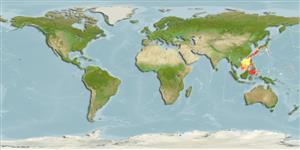
Western Pacific: Philippines, South and East China seas; northward to the Suruga Bay, Japan.
Tamaño / Peso / Edad
Madurez: Lm ? range ? - ? cm
Max length : 80.0 cm TL macho / no sexado; (Ref. 244); 63.0 cm TL (female)
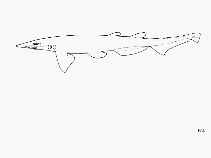
Espinas dorsales (total) : 0; Espinas anales: 0. Diagnostic features include the very short abdomen, with interspace between pectoral and pelvic fins base shorter than 3/5 of anal fin base length; pectoral fin tip reaching beyond the midpoint between pectoral and pelvic fins; first dorsal fin smaller in area than the second dorsal; posterior end base (axil) of second dorsal clearly in front of anal fin axil; low anal fin with a long base. Egg capsule very slender; without tendrils, conical posterior end. Claspers without hooks, with posterior margin of exorhipidion forming a free lobe (Ref. 37959). Black, brown or grey (Ref. 11146), without conspicuous markings on fins (Ref. 244).
Body shape (shape guide): elongated.
Found on the continental slopes. Poorly known. Oviparous, probably one egg per oviduct laid at a time. Not utilized at present.
Ciclo vital y comportamiento de apareamiento
Madurez | Reproducción | Puesta | Huevos | Fecundidad | Larva
Oviparous, paired eggs are laid. Embryos feed solely on yolk (Ref. 50449).
Compagno, L.J.V., 1984. FAO Species Catalogue. Vol. 4. Sharks of the world. An annotated and illustrated catalogue of shark species known to date. Part 2 - Carcharhiniformes. FAO Fish. Synop. 125(4/2):251-655. Rome: FAO. (Ref. 244)
Situación en la Lista Roja de la UICN (Ref. 130435: Version 2025-2 (Global))
Amenaza para el ser humano
Harmless
Usos humanos
Pesquerías: sin interés
Herramientas
Informes especiales
Descargar XML
Fuentes de Internet
Estimaciones basadas en modelos
Temperatura preferida (Referencia
123201): 3 - 10.1, mean 3.4 °C (based on 121 cells).
Índice de diversidad filogenética (Referencia
82804): PD
50 = 0.5000 [Uniqueness, from 0.5 = low to 2.0 = high].
Bayesian length-weight: a=0.00347 (0.00172 - 0.00698), b=3.08 (2.90 - 3.26), in cm total length, based on LWR estimates for this (Sub)family-body shape (Ref.
93245).
Nivel trófico (Referencia
69278): 4.0 ±0.6 se; based on size and trophs of closest relatives
Resiliencia (Referencia
120179): Muy bajo, población duplicada en un tiempo mínimo superior a 14 años (Fec assumed to be <10).
Vulnerabilidad pesquera (Ref.
59153): Moderate to high vulnerability (52 of 100).
🛈