>
Holocentriformes (Squirrelfishes, soldierfishes) >
Holocentridae (Squirrelfishes, soldierfishes) > Myripristinae
Etymology: Myripristis: Greek, myros, -ou = male of morey eel + Greek, pristis = saw (Ref. 45335).
More on author: Castelnau.
Environnement : milieu / zone climatique / profondeur / gamme de distribution
Écologie
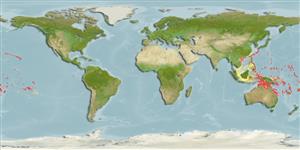
marin récifal; non migrateur; profondeur 25 - 190 m (Ref. 117152), usually 25 - 52 m (Ref. 9710). Tropical; 30°N - 25°S, 102°E - 130°W
Pacific Ocean: Indonesia and the Philippines to Hawaii and Ducie Islands; north to Ryukyu Islands and Marcus Islands throughout Micronesia.
Taille / Poids / Âge
Maturité: Lm ? range ? - ? cm
Max length : 26.5 cm SL mâle / non sexé; (Ref. 54980)
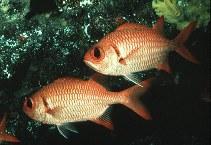
Épines dorsales (Total) : 11; Rayons mous dorsaux (Total) : 13 - 15; Épines anales: 4; Rayons mous anaux: 12 - 13. Fins are uniformly red and lack white leading edges or darker tips.
Body shape (shape guide): fusiform / normal.
Inhabits reef flats and seaward slopes to depths of more than 52 m where it is found in groups in caves and under ledges (Ref. 1602). Benthopelagic (Ref. 58302). Feeds mainly on polychaetes, also on crab megalops, hermit crab larvae, and larvae of alpheid shrimps (Ref. 12419). Forms large schools in oceanic locations (Ref. 48635).
Cycle de vie et comportement reproducteur
Maturité | Reproduction | Frai | Œufs | Fécondité | Larves
Randall, J.E. and D.W. Greenfield, 1996. Revision of the Indo-Pacific holocentrid fishes of the genus Myripristis, with descriptions of three new species. Indo-Pac. Fish. (25):61 p. (Ref. 12419)
Statut dans la liste rouge de l'IUCN (Ref. 130435: Version 2025-2 (Global))
Menace pour l'homme
Harmless
Utilisations par l'homme
Pêcheries: commercial; Aquarium: Commercial
Outils
Articles particuliers
Télécharger en XML
Sources Internet
Estimations basées sur des modèles
Température préférée (Réf.
123201): 24.5 - 28.7, mean 26.5 °C (based on 45 cells).
Indice de diversité phylogénétique (Réf.
82804): PD
50 = 0.5000 [Uniqueness, from 0.5 = low to 2.0 = high].
Bayesian length-weight: a=0.02042 (0.01248 - 0.03339), b=3.08 (2.94 - 3.22), in cm total length, based on LWR estimates for this species & Genus-body shape (Ref.
93245).
Niveau trophique (Réf.
69278): 3.6 ±0.2 se; based on diet studies.
Generation time: 5.0 ( na - na) years. Estimated as median ln(3)/K based on 1
growth studies.
Résilience (Réf.
120179): Milieu, temps minimum de doublement de population : 1,4 à 4,4 années (Preliminary K or Fecundity.).
Vulnérabilité de la pêche (Ref.
59153): Moderate vulnerability (37 of 100).
🛈
Nutriments (Ref.
124155): Calcium = 42.3 [20.2, 135.0] mg/100g; Iron = 0.54 [0.23, 1.07] mg/100g; Protein = 18.3 [17.1, 19.5] %; Omega3 = 0.177 [0.072, 0.402] g/100g; Selenium = 37.8 [22.3, 68.1] μg/100g; VitaminA = 120 [42, 322] μg/100g; Zinc = 1.31 [0.83, 1.98] mg/100g (wet weight);