>
Eupercaria/misc (Various families in series Eupercaria) >
Labridae (Wrasses) > Julidinae
Etymology: Thalassoma: Greek, thalassa = the sea + Greek, soma = body; the colour of the sea (Ref. 45335).
Eponymy: Captain Louis Isidore Duperrey (1786–1865) was a French naval officer (1802). [...] (Ref. 128868), visit book page.
More on authors: Quoy & Gaimard.
Umwelt: Milieu / Klimazone / Tiefenbereich / Verbreitungsgebiet
Ökologie
seewasser riff-verbunden; standorttreu; tiefenbereich 1 - ? m (Ref. 58302), usually 5 - 25 m (Ref. 27115). Tropical; 22°C - 26°C (Ref. 27115); 30°N - 15°N
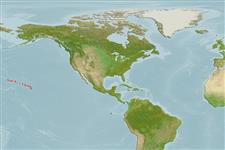
Eastern Central Pacific: Johnston (Ref. 11013) and Hawaiian islands.
Länge bei der ersten Reifung / Größe / Gewicht / Alter
Geschlechtsreife: Lm 9.2, range 6 - 12 cm
Max length : 28.0 cm TL Männchen/unbestimmt; (Ref. 3921)
Kurzbeschreibung
Bestimmungsschlüssel | Morphologie | Morphometrie
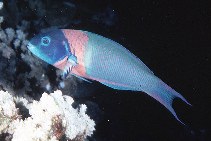
Occur in clear lagoon and seaward reefs (Ref. 9710). Benthopelagic over coral, rock and rubble (Ref. 58302). Feed mainly on benthic animals. Juveniles and adults sometimes act as cleaners (Ref. 9710). Spawning occur either in aggregations by fish in the initial color phase or in pairs, typically with the terminal male being much larger than the female.
Lebenszyklus und Paarungsverhalten
Geschlechtsreife | Fortpflanzung | Ablaichen | Eier | Fruchtbarkeit | Larven
Pelagic spawner. Sex reversal is completed in 8-12 weeks (Ref. 34185, 34261). Also Ref. 38856, 38703. Primary males participate in group spawning and have large testes; secondary males engage in pair-spawning and have smaller, reduced testes (Ref. 48503).
Randall, J.E., 1985. Guide to Hawaiian reef fishes. Harrowood Books, Newtown Square, PA 19073, USA. 74 p. (Ref. 3921)
IUCN Rote Liste Status (Ref. 130435: Version 2025-2 (Global))
Bedrohung für Menschen
Harmless
Nutzung durch Menschen
Fischereien: kommerziell; Aquarium: Kommerziell
Tools
Zusatzinformationen
Download XML
Internet Quellen
Schätzungen auf der Grundlage von Modellen
Bevorzugte Temperatur (Ref.
123201): 24.3 - 26.3, mean 25.1 °C (based on 60 cells).
Phylogenetischer Diversitätsindex (Ref.
82804): PD
50 = 0.5000 [Uniqueness, from 0.5 = low to 2.0 = high].
Bayesian length-weight: a=0.00832 (0.00465 - 0.01489), b=3.01 (2.86 - 3.16), in cm total length, based on LWR estimates for this species & Genus-body shape (Ref.
93245).
Trophische Ebene (Ref.
69278): 3.3 ±0.1 se; based on diet studies.
Widerstandsfähigkeit (Ref.
120179): hoch, Verdopplung der Population dauert weniger als 15 Monate. (tm=1).
Anfälligkeit der Fischerei (Ref.
59153): Low vulnerability (18 of 100).
🛈
Nährstoffe (Ref.
124155): Calcium = 71.2 [43.3, 116.3] mg/100g; Iron = 0.751 [0.440, 1.322] mg/100g; Protein = 18.7 [15.8, 20.9] %; Omega3 = 0.145 [0.098, 0.222] g/100g; Selenium = 32.7 [20.8, 56.9] μg/100g; VitaminA = 71.8 [24.0, 258.1] μg/100g; Zinc = 1.46 [1.05, 2.27] mg/100g (wet weight);