Elasmobranchii (tubarões e raias) (sharks and rays) >
Carcharhiniformes (Ground sharks) >
Pentanchidae (Deepwater catsharks)
Etymology: Apristurus: a-, Latin privative, i.e., without; pristis, from pristes (Gr.), sawyer (but here meaning saw); oura (Gr.), tail, referring to absence of saw-toothed crest of enlarged dermal denticles along upper edge of caudal fin as found in the closely related Pristiurus (=Galeus) (See ETYFish); longicephalus: longus (L.), long; cephalus, from kephale (Gr.), head, about ¼ of total length (See ETYFish).
Ambiente: milieu / zona climática / intervalo de profundidade / gama de distribuição
Ecologia
marinhas batidemersal; intervalo de profundidade 680 - 950 m (Ref. 97621). Deep-water; 39°N - 22°S
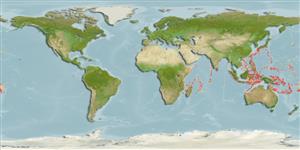
Indo-West Pacific: Seychelles, Japan, East China Sea, Philippines, and Australia. New specimens were caught off western New Caledonia (Coriolis Bank, Lansdowne Bank, Lord Howe Ridge and Fairway Ridge) and off Mozambique (Ref. 53905).
Comprimento na primeira maturidade / Tamanho / Peso / Idade
Maturidade: Lm 51.0 range ? - ? cm
Max length : 60.0 cm TL macho/indeterminado; (Ref. 559)
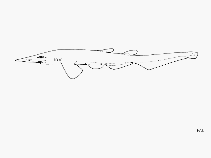
Espinhos dorsais (total) : 0; Espinhos anais: 0. Grey-black, without conspicuous markings (Ref. 244).
Body shape (shape guide): elongated.
Inhabits deep water, probably near the bottom (Ref. 11146). Oviparous (Ref. 50449). First record of a cartilaginous fish manifesting rudimentary hermaphroditism (Ref. 53905). Biology little known (Ref. 6871).
Ciclo de vida e comportamento de acasalamento
Maturidade | Reprodução | Desova | Ovos | Fecundidade | Larvas
Oviparous, paired eggs are laid. Embryos feed solely on yolk (Ref. 50449). First record of a cartilaginous fish manifesting hermaphroditism which is further classified as rudimentary hermaphroditism (Ref. 53905).
Compagno, L.J.V., 1984. FAO Species Catalogue. Vol. 4. Sharks of the world. An annotated and illustrated catalogue of shark species known to date. Part 2 - Carcharhiniformes. FAO Fish. Synop. 125(4/2):251-655. Rome: FAO. (Ref. 244)
Categoria na Lista Vermelha da IUCN (Ref. 130435: Version 2025-2 (Global))
Utilização humana
Pescarias: pouco comercial
Ferramentas
Relatórios especiais
Descarregue XML
Fontes da internet
Estimativas baseadas em modelos
Temperatura preferida (Ref.
123201): 5.2 - 7.4, mean 6 °C (based on 99 cells).
Índice de diversidade filogenética (Ref.
82804): PD
50 = 0.5000 [Uniqueness, from 0.5 = low to 2.0 = high].
Bayesian length-weight: a=0.00347 (0.00172 - 0.00698), b=3.08 (2.90 - 3.26), in cm total length, based on LWR estimates for this (Sub)family-body shape (Ref.
93245).
Nível Trófico (Ref.
69278): 3.9 ±0.6 se; based on size and trophs of closest relatives
Resiliência (Ref.
120179): Muito baixo, tempo mínimo de duplicação da população maior que 14 anos (Fec assumed to be <10).
Vulnerabilidade da pesca (Ref.
59153): Moderate vulnerability (44 of 100).
🛈