Elasmobranchii (Haie und Rochen) (sharks and rays) >
Carcharhiniformes (Ground sharks) >
Pentanchidae (Deepwater catsharks)
Etymology: Apristurus: a-, Latin privative, i.e., without; pristis, from pristes (Gr.), sawyer (but here meaning saw); oura (Gr.), tail, referring to absence of saw-toothed crest of enlarged dermal denticles along upper edge of caudal fin as found in the closely related Pristiurus (=Galeus) (See ETYFish); laurussonii: In honor of Saemundsson’s friend Gísli Lárusson (1865-1935), goldsmith, watchmaker, farmer and nature enthusiast, for his “long and invaluable support of the study of Icelandic fishes, and for carefully encouraging the skillful fishermen of Vestmannaeyjar Island [near type locality]” (translation) (See ETYFish).
Eponymy: Gísli Láurusson (1865–1935) was an Icelander described as ‘Hr Direktur’. [...] (Ref. 128868), visit book page.
Umwelt: Milieu / Klimazone / Tiefenbereich / Verbreitungsgebiet
Ökologie
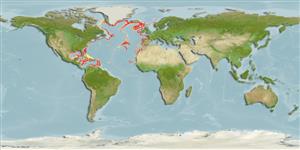
seewasser bathydemersal; tiefenbereich 560 - 1550 m (Ref. 97621). Deep-water; 67°N - 11°N, 98°W - 11°E (Ref. 56872)
Western Atlantic: Massachusetts and Delaware, USA and the northern Gulf of Mexico. Eastern Atlantic: Iceland, southwestern Ireland, Canary Islands and Madeira.
Größe / Gewicht / Alter
Geschlechtsreife: Lm ? range ? - ? cm
Max length : 76.0 cm TL Männchen/unbestimmt; (Ref. 97621); 69.0 cm TL (female)
Fairly common on the upper continental slopes, usually over mud or other soft sea bottom (Ref. 9996). Oviparous (Ref. 50449).
Lebenszyklus und Paarungsverhalten
Geschlechtsreife | Fortpflanzung | Ablaichen | Eier | Fruchtbarkeit | Larven
Oviparous, paired eggs are laid. Embryos feed solely on yolk (Ref. 50449).
Compagno, L.J.V., 1999. Checklist of living elasmobranchs. p. 471-498. In W.C. Hamlett (ed.) Sharks, skates, and rays: the biology of elasmobranch fishes. Johns Hopkins University Press, Maryland. (Ref. 35766)
IUCN Rote Liste Status (Ref. 130435: Version 2025-2 (Global))
Bedrohung für Menschen
Harmless
Nutzung durch Menschen
Fischereien: nicht kommerziell
Tools
Zusatzinformationen
Download XML
Internet Quellen
Schätzungen auf der Grundlage von Modellen
Bevorzugte Temperatur (Ref.
123201): 3.6 - 10.1, mean 6.7 °C (based on 250 cells).
Phylogenetischer Diversitätsindex (Ref.
82804): PD
50 = 0.5000 [Uniqueness, from 0.5 = low to 2.0 = high].
Bayesian length-weight: a=0.00347 (0.00172 - 0.00698), b=3.08 (2.90 - 3.26), in cm total length, based on LWR estimates for this (Sub)family-body shape (Ref.
93245).
Trophische Ebene (Ref.
69278): 4.0 ±0.6 se; based on diet studies.
Widerstandsfähigkeit (Ref.
120179): sehr niedrig, Verdopplung der Population dauert mehr als 14 Jahre. (Fec assumed to be <10).
Anfälligkeit der Fischerei (Ref.
59153): Moderate to high vulnerability (50 of 100).
🛈
Nährstoffe (Ref.
124155): Calcium = 9.53 [1.72, 58.09] mg/100g; Iron = 0.338 [0.075, 1.163] mg/100g; Protein = 18.8 [16.7, 21.0] %; Omega3 = 0.234 [0.090, 0.612] g/100g; Selenium = 16.1 [4.9, 53.6] μg/100g; VitaminA = 6.11 [1.23, 28.29] μg/100g; Zinc = 0.296 [0.148, 0.550] mg/100g (wet weight);