Elasmobranquios (tiburones y rayas) (sharks and rays) >
Carcharhiniformes (Ground sharks) >
Pentanchidae (Deepwater catsharks)
Etymology: Apristurus: a-, Latin privative, i.e., without; pristis, from pristes (Gr.), sawyer (but here meaning saw); oura (Gr.), tail, referring to absence of saw-toothed crest of enlarged dermal denticles along upper edge of caudal fin as found in the closely related Pristiurus (=Galeus) (See ETYFish); kampae: In honor of Elizabeth Kampa Boden (1922-1986), Scripps Institution of Oceanography, chief scientist aboard the research vessel Argos, from which holotype was collected (See ETYFish).
Eponymy: Dr Elizabeth Maitland Boden née Kampa (1922–1986) was an oceanographer who was chief scientist on board the research vessel ‘Argos’ (1970) from which the type specimen was collected. [...] (Ref. 128868), visit book page.
Entorno: milieu / zona climática / rango de profundidad / gama de distribución
Ecología
marino batidemersal; rango de profundidad ? - 1888 m (Ref. 58018). Deep-water; 38°N - 23°N
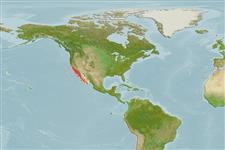
Eastern Central Pacific: central and southern California, USA and Gulf of California. A report of a specimen from the Galapagos may be another species of uncertain identity (Ref. 6478) or a conspecific of this species.
Tamaño / Peso / Edad
Madurez: Lm ? range ? - ? cm
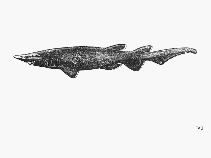
Max length : 58.4 cm TL macho / no sexado; (Ref. 244); 52.0 cm TL (female)
Found on the eastern Pacific upper continental slope. Oviparous, with a single egg laid per oviduct.
Ciclo vital y comportamiento de apareamiento
Madurez | Reproducción | Puesta | Huevos | Fecundidad | Larva
Oviparous, paired eggs are laid. Embryos feed solely on yolk (Ref. 50449).
Compagno, L.J.V., 1984. FAO Species Catalogue. Vol. 4. Sharks of the world. An annotated and illustrated catalogue of shark species known to date. Part 2 - Carcharhiniformes. FAO Fish. Synop. 125(4/2):251-655. Rome: FAO. (Ref. 244)
Situación en la Lista Roja de la UICN (Ref. 130435: Version 2025-2 (Global))
Amenaza para el ser humano
Harmless
Usos humanos
Pesquerías: pesquerías de subsistencia
Herramientas
Informes especiales
Descargar XML
Fuentes de Internet
Estimaciones basadas en modelos
Temperatura preferida (Referencia
123201): 4.5 - 8.8, mean 5.4 °C (based on 20 cells).
Índice de diversidad filogenética (Referencia
82804): PD
50 = 0.5000 [Uniqueness, from 0.5 = low to 2.0 = high].
Bayesian length-weight: a=0.00347 (0.00172 - 0.00698), b=3.08 (2.90 - 3.26), in cm total length, based on LWR estimates for this (Sub)family-body shape (Ref.
93245).
Nivel trófico (Referencia
69278): 3.9 ±0.6 se; based on size and trophs of closest relatives
Resiliencia (Referencia
120179): Muy bajo, población duplicada en un tiempo mínimo superior a 14 años (Fec=2).
Vulnerabilidad pesquera (Ref.
59153): Moderate vulnerability (43 of 100).
🛈