>
Gobiiformes (Gobies) >
Gobiidae (Gobies) > Gobiinae
Etymology: Eviota: No etymology given, suggested by Christopher Scharpt: from Latin 'eu' for 'true' and 'iota' for anything very small, in combination 'truly very small' referring to it as being the smallest vertebrate at the time it has benn described by Jenkins (thus, making the suggestion by Scharpt plausible.
Ambiente: milieu / zona climatica / distribuzione batimetrica / gamma di distribuzione
Ecologia
marino associati a barriera corallina. Tropical
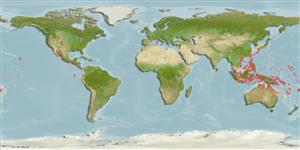
Indo-Pacific: Japan, Micronesia (Palau and Yap), Hong Kong, northern Vietnam, Philippines, Indonesia (Java and Kalimantan to West Papua), and Western Australia.
Dimensione / Peso / Età
Maturità: Lm ? range ? - ? cm
Max length : 2.5 cm SL maschio/sesso non determinato; (Ref. 48637)
Breve descrizione
Chiavi di identificazione | Morfologia | Morfometria
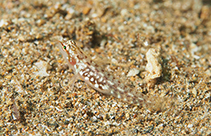
Spine dorsali (totale) : 7 - 8; Raggi dorsali molli (totale) : 8 - 9; Spine anali: 1; Raggi anali molli: 7. Characterized by semi-translucent greyish body with internal stripe of alternating white and reddish brown; large brownish patch on lower side just posterior to pectoral fin base punctuated with large irregular white spots; from nape, along dorsal fin base, to dorsal surface of caudal peduncle with 14 brown spots/saddles; above anal fin base with 6-7 similar brown and white marks; first four dorsal spines of male and first two spines of female often elongate and filamentous; all pectoral rays unbranched; longitudinal scale series 22-23; ctenoid scales except on head, nape, breast and pectoral fin base; separated pelvic fins, bases joined by thin membrane; fourth pelvic ray with 2-8 branches; depth of body 4.0-4.5 in SL (Ref. 90102).
Body shape (shape guide): elongated.
Inhabits shallow inshore algal reefs (Ref. 48637).
Ciclo vitale e comportamento di accoppiamento
Maturità | Riproduzione | Deposizione | Uova | Fecondità | Larve
Lachner, E.A. and S.J. Karnella, 1980. Fishes of the Indo-Pacific genus Eviota with descriptions of eight new species (Teleostei:Gobiidae). Smithson. Contrib. Zool. (315):127 p. (Ref. 5293)
Stato della Lista Rossa IUCN (Ref. 130435: Version 2025-2 (Global))
Minaccia per l'uomo
Harmless
Usi umani
Strumenti
Rapporti speciali
Scarica XML
Fonti Internet
Stime basate su modelli
Temperatura preferita (Fonte Biblio.
123201): 24.9 - 29.3, mean 28.6 °C (based on 1961 cells).
Indice di diversità filogenetica (Fonte Biblio.
82804): PD
50 = 0.5000 [Uniqueness, from 0.5 = low to 2.0 = high].
Bayesian length-weight: a=0.00692 (0.00281 - 0.01706), b=3.09 (2.92 - 3.26), in cm total length, based on LWR estimates for this Genus-body shape (Ref.
93245).
Livello trofico (Fonte Biblio.
69278): 3.1 ±0.3 se; based on size and trophs of closest relatives
Resilienza (Fonte Biblio.
120179): Alto, tempo minimo di raddoppiamento della popolazione meno di 15 mesi (Preliminary K or Fecundity.).
Vulnerabilità della pesca (Ref.
59153): Low vulnerability (10 of 100).
🛈
Nutrienti (Ref.
124155): Calcium = 409 [171, 1,195] mg/100g; Iron = 1.55 [0.66, 3.47] mg/100g; Protein = 17.6 [15.5, 19.5] %; Omega3 = 0.104 [0.035, 0.292] g/100g; Selenium = 31.8 [9.4, 94.2] μg/100g; VitaminA = 123 [24, 599] μg/100g; Zinc = 4.33 [2.38, 7.27] mg/100g (wet weight);