>
Syngnathiformes (Pipefishes and seahorses) >
Syngnathidae (Pipefishes and seahorses) > Nerophinae
Etymology: Nerophis: Greek, neros, nearos = youhtfull appearance + Greek,ophis = serpent (Ref. 45335).
More on author: Jenyns.
Entorno: milieu / zona climática / rango de profundidad / gama de distribución
Ecología
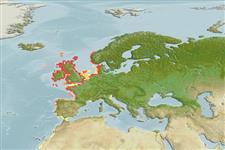
marino demersal; rango de profundidad 0 - 30 m (Ref. 6733). Temperate; 63°N - 21°N, 18°W - 13°E
Eastern Atlantic: southern Norway, Kattegat and British Isles to Rio de Oro in Western Sahara.
Tamaño / Peso / Edad
Madurez: Lm ? range ? - ? cm
Max length : 15.0 cm TL macho / no sexado; (Ref. 6733); 17.0 cm TL (female)
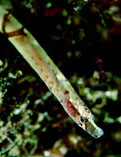
Pectoral and caudal fins absent. Anal opening below front end of the dorsal fin. With 17-19 body rings. The snout is short and bent upwards (Ref. 35388).
Body shape (shape guide): eel-like.
Intertidal to about 30 m (Ref. 6733), among rocks or holdfasts and lower branches of algae (Ref. 4509). Spawn in the summer months. Become sexually mature at an age of 2 years. Feed on small crustaceans and fish fry (Ref. 35388). Larvae are attached to the ventral surface of the males (Ref. 42359). Ovoviviparous (Ref. 205). Parental care is exclusively paternal (Ref. 42359). The male carries the eggs in a brood pouch which is found under the tail (Ref. 205).
Males brood their offspring attached to their flattened ventral surface. All throughout the gestation period, parental care is strictly paternal. No further care is needed once the newborn juveniles become free-swimming (Ref. 42359).
Sex roles are reversed in this species. The females are the courting sex and change color more intensely than the males (Ref. 42363). Unlike in other pipefishes, the courtship ritual takes place in close contact with the substratum which may characterise adaptation to typical intertidal conditions (Ref. 42363).
Dawson, C.E., 1990. Syngnathidae. p. 658-664. In J.C. Quero, J.C. Hureau, C. Karrer, A. Post and L. Saldanha (eds.) Check-list of the fishes of the eastern tropical Atlantic (CLOFETA). JNICT, Lisbon; SEI, Paris; and UNESCO, Paris. Vol. 2. (Ref. 4509)
Situación en la Lista Roja de la UICN (Ref. 130435: Version 2025-2 (Global))
Amenaza para el ser humano
Harmless
Usos humanos
Herramientas
Informes especiales
Descargar XML
Fuentes de Internet
Estimaciones basadas en modelos
Temperatura preferida (Referencia
123201): 9.4 - 16, mean 11 °C (based on 394 cells).
Índice de diversidad filogenética (Referencia
82804): PD
50 = 0.6250 [Uniqueness, from 0.5 = low to 2.0 = high].
Bayesian length-weight: a=0.00098 (0.00038 - 0.00252), b=3.05 (2.83 - 3.27), in cm total length, based on LWR estimates for this (Sub)family-body shape (Ref.
93245).
Nivel trófico (Referencia
69278): 4.0 ±0.67 se; based on food items.
Resiliencia (Referencia
120179): Medio, población duplicada en un tiempo mínimo de 1.4-4.4 años (tm=2).
Vulnerabilidad pesquera (Ref.
59153): Low vulnerability (10 of 100).
🛈
Nutrientes (Ref.
124155): Calcium = 51.7 [12.4, 166.8] mg/100g; Iron = 0.418 [0.161, 1.506] mg/100g; Protein = 3.03 [0.00, 6.79] %; Omega3 = 0.503 [0.208, 1.241] g/100g; Selenium = 5.86 [1.11, 18.63] μg/100g; VitaminA = 28.5 [7.3, 99.9] μg/100g; Zinc = 0.688 [0.335, 1.357] mg/100g (wet weight);