Elasmobranquios (tiburones y rayas) (sharks and rays) >
Rajiformes (Skates and rays) >
Rajidae (Skates)
Etymology: Rajella: Latin, raja, -ae = a sting ray (Raja sp.) (Ref. 45335).
Eponymy: This species is named after the Danish vessel ‘Fylla’ which was used for expeditions to Greenland (1884 & 1886), on one of which the holotype was collected. (Ref. 128868), visit book page.
More on author: Lütken.
Entorno: milieu / zona climática / rango de profundidad / gama de distribución
Ecología
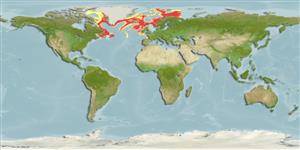
marino batidemersal; rango de profundidad 147 - 2055 m (Ref. 106604), usually 300 - 800 m (Ref. 3167). Deep-water; 1°C - 7°C (Ref. 117245); 84°N - 40°N, 75°W - 55°E (Ref. 114953)
North Atlantic and adjacent fringes of the Arctic Region: offshore of Gulf of Maine and slopes off Newfoundland banks and Labrador to southern Baffin Bay, around southern Greenland to Denmark Strait, south of Iceland, and along Faroe-Shetland ridge to the Skagerrak; west of British Isles from Porcupine Bank and Rockall Plateau to Faroe Islands; and off Norwegian coasts to western Barents Sea and Svalbard.
Tamaño / Peso / Edad
Madurez: Lm ? range ? - ? cm
Max length : 60.0 cm TL macho / no sexado; (Ref. 35388)
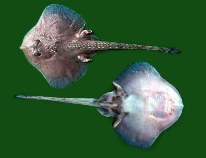
Snout is short and obtuse. Midbelt of its disc and upper surface of its tail are rough with large thorns in irregular rows. Upper surface ash gray to chocolate brown. Lower surface white, grayish white, pale gray or light fawn color, sooty patches on pelvic fins and axils of pectoral fins (Ref. 6902).
Body shape (shape guide): other.
Found in deeper shelf and slope waters, in 3-5.5°C water temperature (6902). Benthic (Ref. 58426). Feed on all kinds of bottom animals with preference for invertebrates (Ref. 3167) like copepods, amphipods and mysids (Ref. 6902). Oviparous. Distinct pairing with embrace. Young may tend to follow large objects, such as their mother (Ref. 205). Eggs are oblong capsules with stiff pointed horns at the corners deposited in sandy or muddy flats (Ref. 205). Egg capsules are 3.8-4.2 cm long and 2.4-2.6 cm wide (Ref. 41303, 41251, 41301). It is captured at low level by-catch in bottom-trawl and longline fisheries (Ref. 117245).
Ciclo vital y comportamiento de apareamiento
Madurez | Reproducción | Puesta | Huevos | Fecundidad | Larva
Oviparous, paired eggs are laid. Embryos feed solely on yolk (Ref. 50449). Distinct pairing with embrace. Young may tend to follow large objects, such as their mother (Ref. 205).
McEachran, J.D. and K.A. Dunn, 1998. Phylogenetic analysis of skates, a morphologically conservative clade of elasmobranchs (Chondrichthyes: Rajidae). Copeia 1998(2):271-290. (Ref. 27314)
Situación en la Lista Roja de la UICN (Ref. 130435: Version 2025-2 (Global))
Amenaza para el ser humano
Harmless
Usos humanos
Pesquerías: sin interés
Herramientas
Informes especiales
Descargar XML
Fuentes de Internet
Estimaciones basadas en modelos
Temperatura preferida (Referencia
123201): 0.7 - 9.5, mean 3.6 °C (based on 707 cells).
Índice de diversidad filogenética (Referencia
82804): PD
50 = 0.5000 [Uniqueness, from 0.5 = low to 2.0 = high].
Bayesian length-weight: a=0.00302 (0.00141 - 0.00645), b=3.24 (3.07 - 3.41), in cm total length, based on LWR estimates for this (Sub)family-body shape (Ref.
93245).
Nivel trófico (Referencia
69278): 3.4 ±0.2 se; based on diet studies.
Resiliencia (Referencia
120179): Bajo, población duplicada en un tiempo mínimo de 4.5-14 años (Fec assumed to be <100).
Vulnerabilidad pesquera (Ref.
59153): Moderate vulnerability (44 of 100).
🛈
Nutrientes (Ref.
124155): Calcium = 5.49 [0.80, 107.06] mg/100g; Iron = 0.328 [0.031, 4.452] mg/100g; Protein = 15.1 [13.0, 17.1] %; Omega3 = 0.494 [0.195, 1.253] g/100g; Selenium = 17.8 [3.1, 85.5] μg/100g; VitaminA = 4.75 [0.34, 63.37] μg/100g; Zinc = 0.305 [0.021, 3.468] mg/100g (wet weight);