Environnement : milieu / zone climatique / profondeur / gamme de distribution
Écologie
marin bathydémersal; profondeur 100 - 500 m (Ref. 11897). Deep-water
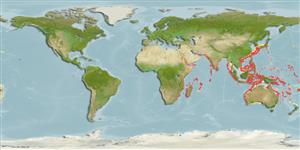
Indian Ocean: from the Andaman Sea and may extend nearby (i.e. India).
Taille / Poids / Âge
Maturité: Lm ? range ? - ? cm
Max length : 10.0 cm TL mâle / non sexé; (Ref. 6612)
Description synthétique
Clés d'identification | Morphologie | Morphométrie
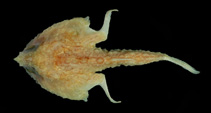
Rayons mous dorsaux (Total) : 5; Épines anales: 0; Rayons mous anaux: 4. This species is characterized by the following: subopercular buckler dull, with many small blunt spinelets at its tip; the ventral surface is covered with small- to mid-bucklers, totally naked between these bucklers; relatively short and blunt rostrum, directed upward; principal bucklers on dorsal surface relatively small and low; dorsal surface with few brown rings (Ref. 86633).
Body shape (shape guide): other (see remarks); Cross section: flattened.
A benthic species (Ref. 75154) found on the continental slope (Ref. 7300, 75154).
Cycle de vie et comportement reproducteur
Maturité | Reproduction | Frai | Œufs | Fécondité | Larves
Paxton, J.R., D.F. Hoese, G.R. Allen and J.E. Hanley, 1989. Pisces. Petromyzontidae to Carangidae. Zoological Catalogue of Australia, Vol. 7. Australian Government Publishing Service, Canberra, 665 p. (Ref. 7300)
Statut dans la liste rouge de l'IUCN (Ref. 130435: Version 2025-2 (Global))
Menace pour l'homme
Harmless
Utilisations par l'homme
Pêcheries: bycatch
Outils
Articles particuliers
Télécharger en XML
Sources Internet
Estimations basées sur des modèles
Température préférée (Réf.
123201): 11.8 - 22.9, mean 15.9 °C (based on 294 cells).
Indice de diversité phylogénétique (Réf.
82804): PD
50 = 0.5000 [Uniqueness, from 0.5 = low to 2.0 = high].
Bayesian length-weight: a=0.01514 (0.00541 - 0.04235), b=2.93 (2.68 - 3.18), in cm total length, based on LWR estimates for this (Sub)family-body shape (Ref.
93245).
Niveau trophique (Réf.
69278): 3.3 ±0.5 se; based on size and trophs of closest relatives
Résilience (Réf.
120179): Milieu, temps minimum de doublement de population : 1,4 à 4,4 années (Preliminary K or Fecundity.).
Vulnérabilité de la pêche (Ref.
59153): Low vulnerability (10 of 100).
🛈