>
Eupercaria/misc (Various families in series Eupercaria) >
Labridae (Wrasses) > Julidinae
Etymology: Hologymnosus: Greek, holos = full + Greek, gymnos = naked (Ref. 45335).
More on authors: Randall & Yamakawa.
Ambiente: milieu / zona climatica / distribuzione batimetrica / gamma di distribuzione
Ecologia
marino associati a barriera corallina; distribuzione batimetrica 15 - 40 m (Ref. 90102). Tropical
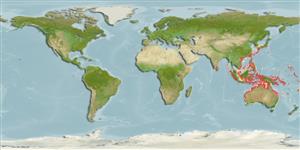
Western Pacific: Japan to Indonesia.
Dimensione / Peso / Età
Maturità: Lm ? range ? - ? cm
Max length : 32.0 cm TL maschio/sesso non determinato; (Ref. 9710)
Breve descrizione
Chiavi di identificazione | Morfologia | Morfometria
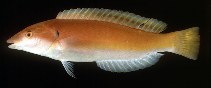
Spine dorsali (totale) : 9; Raggi dorsali molli (totale) : 12; Spine anali: 3; Raggi anali molli: 12.
Body shape (shape guide): fusiform / normal.
Inhabits seaward reefs, in areas of mixed sand, rubble, and coral (Ref. 9710). Often found in areas with Halimeda algea. May be solitray or form groups. East indian reef fishes of this species are mostly young and rarely larger than 10 cm (Ref. 90102).
Ciclo vitale e comportamento di accoppiamento
Maturità | Riproduzione | Deposizione | Uova | Fecondità | Larve
Oviparous, distinct pairing during breeding (Ref. 205).
Randall, J.E. and T. Yamakawa, 1988. A new species of the labrid fish of the genus Hologymnosus from the Western Pacific, with notes on H. longipes. Rev. Fr. Aquariol. 15(1):25-30. (Ref. 5277)
Stato della Lista Rossa IUCN (Ref. 130435: Version 2025-2 (Global))
Minaccia per l'uomo
Harmless
Usi umani
Strumenti
Rapporti speciali
Scarica XML
Fonti Internet
Stime basate su modelli
Temperatura preferita (Fonte Biblio.
123201): 20.6 - 28.8, mean 27.4 °C (based on 174 cells).
Indice di diversità filogenetica (Fonte Biblio.
82804): PD
50 = 0.5625 [Uniqueness, from 0.5 = low to 2.0 = high].
Bayesian length-weight: a=0.00977 (0.00468 - 0.02039), b=3.07 (2.90 - 3.24), in cm total length, based on LWR estimates for this (Sub)family-body shape (Ref.
93245).
Livello trofico (Fonte Biblio.
69278): 3.9 ±0.6 se; based on size and trophs of closest relatives
Resilienza (Fonte Biblio.
120179): Medio, tempo minimo di raddoppiamento della popolazione 1.4 - 4.4 anni (Preliminary K or Fecundity.).
Vulnerabilità della pesca (Ref.
59153): Low vulnerability (22 of 100).
🛈