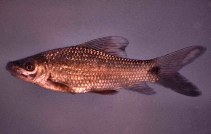
Ambiente: milieu / zona climatica / distribuzione batimetrica / gamma di distribuzione
Ecologia
; acqua dolce benthopelagico; potamodromo (Ref. 51243). Subtropical; 23°S - 34°S
Africa: within the drainage basin of the Orange river and in southern watersheds of the Cape region. There are records of Labeo umbratus from the Olifant's river (Limpopo system) where it has been introduced by anglers. Has also been translocated in the Olifants-Limpopo system in Transvaal (Ref. 7248)
Dimensione / Peso / Età
Maturità: Lm ? range ? - ? cm
Max length : 50.0 cm TL maschio/sesso non determinato; (Ref. 7248); peso massimo pubblicato: 2.9 kg (Ref. 7248)
Closely resembles L. capensis in coloration and in having well developed anterior barbels. Survives temperatures below 10°C. Found mainly in standing waters, shallow dams and muddy shallow areas such as in large impoundments. Juveniles feed on small invertebrates while adults feed on detritus and mud. Valued as an important, nutritious food source and is recommended for use in wastewater aquaculture in combination with other aquatic organisms (Ref. 6465).
Ciclo vitale e comportamento di accoppiamento
Maturità | Riproduzione | Deposizione | Uova | Fecondità | Larve
Reid, G.M., 1985. A revision of African species of Labeo (Pisces: Cyprinidae) and a re-definition of the genus. Verlag von J. Cramer, Braunschweig. 322 p. (Ref. 1440)
Stato della Lista Rossa IUCN (Ref. 130435: Version 2025-2 (Global))
Minaccia per l'uomo
Harmless
Usi umani
Pesca: commerciale; Acquacoltura: sperimentale; Pesce da pesca sportiva: si
Strumenti
Rapporti speciali
Scarica XML
Fonti Internet
Stime basate su modelli
Indice di diversità filogenetica (Fonte Biblio.
82804): PD
50 = 0.5000 [Uniqueness, from 0.5 = low to 2.0 = high].
Bayesian length-weight: a=0.00912 (0.00420 - 0.01982), b=3.05 (2.88 - 3.22), in cm total length, based on LWR estimates for this Genus-body shape (Ref.
93245).
Livello trofico (Fonte Biblio.
69278): 2.8 ±0.38 se; based on food items.
Resilienza (Fonte Biblio.
120179): Medio, tempo minimo di raddoppiamento della popolazione 1.4 - 4.4 anni (Preliminary K or Fecundity.).
Vulnerabilità della pesca (Ref.
59153): Moderate vulnerability (40 of 100).
🛈