>
Blenniiformes (Blennies) >
Blenniidae (Combtooth blennies) > Salariinae
Etymology: Blenniella: Diminutive of blennius, Greek,blenios = mucus (Ref. 45335).
More on author: Bleeker.
Taxonomic Remarks
Genus Williams, pers. comm.
สิ่งแวดล้อม : สิ่งแวดล้อม / เขตภูมิอากาศ / ระดับความลึก / ระยะการกระจายสินค้า
นิเวศวิทยา
เกี่ยวกับทะเล,น้ำเค็ม เกี่ยวกับหินโสโครก; ระดับความลึก 0 - 3 m (Ref. 90102). Tropical; 30°N - 30°S
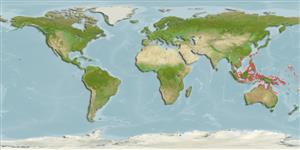
Western Pacific: Ryukyu Islands southward to McClure and New Year Islands, Northern Territory, Australia.
ขนาด / น้ำหนัก / อายุ
วัยเจริญพันธุ์: Lm ? range ? - ? cm
Max length : 16.0 cm TL เพศผู้/กระเทย; (Ref. 48636)
คำอธิบายสั้นๆ
เครื่องมือที่ใช้ในการแยกชนิดสัตว์,สิ่งมีชีวิตออกจากกัน | สัณฐานวิทยา | ความยาวต่างๆ
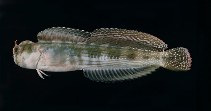
เงี่ยงครีบหลัง (รวม) : 12 - 14; ก้านครีบอ่อนที่หาง (รวม) : 19 - 22; เงี่ยงครีบก้น: 2; ก้านครีบอ่อนที่ก้น: 18 - 22; สัตว์มีกระดูกสันหลัง: 37 - 41. Diagnosis: Dorsal fin XII-XIV, 19-22, notched between spinous and segmented-ray portions; anal fin II, 18-22; pectoral rays 13-15 (usually 14); pelvic fin I, 3; caudal fin, procurrent rays 10-14, segmented rays 11-13. Vertebrae 11-12 + 26-29. Orbital cirrus simple filamentous; nasal cirri short and palmate with 2-6 branches; nape without cirri. Lateral line, continuous anterodorsally with simple pores below dorsal spines from 6-7th to 9-10th, disconnected bi-pored series posteroventrally ending below 9th dorsal spine to 1st segmented ray. Mandibular pores 5-7 Lips margin entire. Occipital crest low (up to 2.6 mm) in males, most females only have faint indication of ridge-like crest precursor except greatest specimens which may have a developed ridge up to 0.6 mm (Ref. 559, 9962). Body depth at anal-fin origin 6.8-7.3 in SL. Male body with vertical bars olive brown separated by paler interspaces, and also with dark thin horizontal stripes; also with spots near the tail; preopercular spot dark; dorsal fin spots brown, forming bands. Female with vertical dark H-shaped bars; dorsal fin spotted, caudal fin with 4-5 dark bars (Ref. 48636, 90102). Exhibits geographical color pattern variation (Ref. 9962).
Body shape (shape guide): elongated; Cross section: circular.
Adults occur in intertidal zones in large rock pools or coastal bays (Ref. 48636). Found near-shore (Ref. 9962); common in tide pools (Ref. 559). They feed on algae scraped from rubble or rock surfaces. Sometimes numerous individuals can be seen clinging to rocks out of the water when the level drops on the low of the swell. When disturbed in rock pools during low tide, they may jump out of the water to get to other rock pools or safer deeper water nearby (Ref. 48636). Oviparous. Eggs are demersal and adhesive (Ref. 205), and are attached to the substrate via a filamentous, adhesive pad or pedestal (Ref. 94114). Larvae are planktonic, often found in shallow, coastal waters (Ref. 94114).
Distinct pairing (Ref. 205).
Springer, V.G. and J.T. Williams, 1994. The Indo-West Pacific blenniid fish genus Istiblennius reappraised: a revision of Istiblennius, Blenniella, and Paralticus, new genus. Smithson. Contrib. Zool. 565:1-193. (Ref. 9962)
สถานะบัญชีแดงของ IUCN (Ref. 130435: Version 2025-2 (Global))
ภัยคุกคามต่อมนุษย์
Harmless
การใช้ของมนุษย์
การประมง: ไม่มีผลประโยชน์
เครื่องมือ
รายงานพิเศษ
ดาวน์โหลด XML
แหล่งที่มาจากอินเตอร์เน็ต
การประมาณค่าตามแบบจำลอง
อุณหภูมิที่ต้องการ (อ้างอิง
123201): 25.4 - 29.3, mean 28.8 °C (based on 1414 cells).
ดัชนีความหลากหลายทางวิวัฒนาการ (อ้างอิง
82804): PD
50 = 0.5020 [Uniqueness, from 0.5 = low to 2.0 = high].
Bayesian length-weight: a=0.00776 (0.00354 - 0.01702), b=3.00 (2.81 - 3.19), in cm total length, based on LWR estimates for this (Sub)family-body shape (Ref.
93245).
ระดับชั้นอาหาร (อ้างอิง
69278): 2.0 ±0.1 se; based on diet studies.
ความสามารถในการกลับคืนสู่ปกติ (อ้างอิง
120179): ความสูง, เวลาต่ำสุดที่จะทำให้ประชากรเพิ่มขึ้นเป็น 2 เท่าใช้เวลาน้อยกว่า 15 เดือน (Preliminary K or Fecundity.).
ความเสี่ยงต่อการตกปลา (Ref.
59153): Low vulnerability (10 of 100).
🛈
สารอาหาร (Ref.
124155): Calcium = 122 [59, 218] mg/100g; Iron = 0.748 [0.407, 1.330] mg/100g; Protein = 18 [17, 19] %; Omega3 = 0.065 [0.032, 0.125] g/100g; Selenium = 18.3 [8.5, 42.8] μg/100g; VitaminA = 102 [24, 432] μg/100g; Zinc = 2.37 [1.53, 3.52] mg/100g (wet weight);