分類 / 名前
共通名の | 類義語 | Catalog of Fishes(部類, 種) | ITIS | CoL | WoRMS | Cloffa
板鰓亜鋼(サメとエイ類) (sharks and rays) >
Orectolobiformes (Carpet sharks) >
Orectolobidae (Carpet or nurse sharks)
Etymology: Eucrossorhinus: eu (Gr.), very; Crossorhinus (=Orectolobus), previous genus, from krossos (Gr.), fringe or tassel, referring to tassel of dermal lobes fringing the head, and rhinus, an ancient name for sharks, from rhine (Gr.), rasp, alluding to their rasp-like skin, or rhinos, snout, referring to “lobe-like attachments from the nose” (translation, from Müller & Henle’s 1837 description of Crossorhinus) (See ETYFish); dasypogon: dasys (Gr.), hairy; pogon (Gr.), beard, referring to dense beard-like tassel of dermal lobes fringing the head (See ETYFish).
More on author: Bleeker.
環境:環境 / 気候帯 / 深さの範囲 / 分布範囲
生態学
海 関連する礁; 深さの範囲 2 - 50 m (Ref. 106604). Deep-water; 1°N - 23°S, 115°E - 155°E
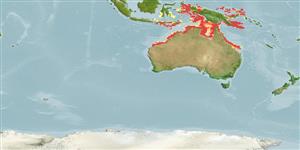
Indo-West Pacific: eastern Indonesia, Papua New Guinea, and northern Australia (including Barrow Island, Western Australia). Questionable occurrence in Malaysia.
サイズ / 重さ / 年齢
成熟: Lm ? range ? - ? cm
Max length : 366 cm TL オス/雌雄の選別がない; (Ref. 90102); common length : 180 cm TL オス/雌雄の選別がない; (Ref. 90102)
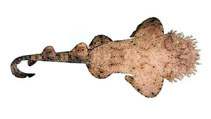
背面の脊椎 (合計) : 0; 肛門の骨: 0. Body with a reticular pattern of narrow dark lines (Ref. 13577). Caudal fin with its upper lobe hardly elevated above the body axis, with a strong terminal lobe and subterminal notch but no ventral lobe (Ref. 13577).
Body shape (shape guide): elongated.
A little-known shark (Ref. 247) found on the continental shelf and offshore reefs (Ref. 6871). Probably feeds on bottom fishes and invertebrates (Ref. 13577, 43278); also known to eat nocturnal teleost fishes such as squirrelfish and soldierfish (Holocentridae) and sweepers (Pempheridae) (Ref. 43278). Ovoviviparous (Ref. 50449). Might bite in self-defense or when mistaking a human foot for its usual prey (Ref. 247). Its tough skin sometimes used for leather (Ref. 13577). The maximum length of 366 cm TL reported for this species is uncertain (Ref. 247, 90102).
ライフサイクルと交尾行動
成熟 | 繁殖 | 放精 | 卵 | 生産力 | 幼生
Ovoviviparous, embryos feed solely on yolk (Ref. 50449).
Compagno, L.J.V., 1984. FAO Species Catalogue. Vol. 4. Sharks of the world. An annotated and illustrated catalogue of shark species known to date. Part 1 - Hexanchiformes to Lamniformes. FAO Fish. Synop. 125(4/1):1-249. Rome, FAO. (Ref. 247)
IUCNのレッドリストの状況は (Ref. 130435: Version 2025-2 (Global))
人間の用途
水産業: bycatch
用具
特記事項
XMLをダウンロードして下さい
インターネットの情報源
モデルに基づく推定値
好ましい温度 (参照
123201): 26.2 - 28.8, mean 27.8 °C (based on 294 cells).
系統多様性指数 (参照
82804): PD
50 = 1.0002 [Uniqueness, from 0.5 = low to 2.0 = high].
Bayesian length-weight: a=0.00389 (0.00180 - 0.00842), b=3.12 (2.94 - 3.30), in cm total length, based on all LWR estimates for this body shape (Ref.
93245).
栄養段階 (参照
69278): 4.0 ±0.60 se; based on food items.
回復力 (参照
120179): 低い, 4.5年~14年の倍増期間の最小個体群 (Fec assumed to be <100).
漁業の脆弱性 (Ref.
59153): Very high vulnerability (90 of 100).
🛈
栄養素 (Ref.
124155): Calcium = 1.57 [0.18, 7.23] mg/100g; Iron = 0.125 [0.027, 0.423] mg/100g; Protein = 19.4 [17.1, 21.6] %; Omega3 = 0.0936 [, ] g/100g; Selenium = 7.92 [2.19, 30.75] μg/100g; VitaminA = 13.4 [2.3, 84.0] μg/100g; Zinc = 0.248 [0.114, 0.523] mg/100g (wet weight);