>
Siluriformes (Catfishes) >
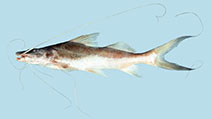
Pimelodidae (Long-whiskered catfishes)
Etymology: Brachyplatystoma: Greek, brachys, eia = short + Greek, platys = flat + Greek, stoma = mouth (Ref. 45335).
Eponymy: François Levaillant (1753–1824) was a French traveller, explorer, collector and naturalist. [...] (Ref. 128868), visit book page.
More on author: Valenciennes.
Ambiente: milieu / zona climática / intervalo de profundidade / gama de distribuição
Ecologia
; Água doce; estuarina demersal; potamódromo (Ref. 138143). Tropical
South America: Amazon and Orinoco River basins and major rivers of the Guianas and northeastern Brazil.
Tamanho / Peso / Idade
Maturidade: Lm ? range ? - ? cm
Max length : 150 cm TL macho/indeterminado; (Ref. 5217); common length : 80.0 cm TL macho/indeterminado; (Ref. 5217); peso máx. Publicado: 20.0 kg (Ref. 5273)
Juveniles and subadults frequently found at river mouths and estuaries. They occur downstream from the first falls where the water is charged with mud and the bottom is muddy. In the Amazon, they can sometimes be caught in the upper part up to the foot of the Andean range where they appear to be more rare than Brachyplatystoma filamentosum and Brachyplatystoma flavicus but never in the zones prone to flood. Reproductive migrations probably occur like in other Brachyplatystoma (Ref. 35381). Usually caught with longlines and drift nets (Ref. 35381). Flesh of excellent quality is highly appreciated.
Ciclo de vida e comportamento de acasalamento
Maturidade | Reprodução | Desova | Ovos | Fecundidade | Larvas
Lundberg, J.G. and M.W. Littmann, 2003. Pimelodidae (Long-whiskered catfishes). p. 432-446. In R.E. Reis, S.O. Kullander and C.J. Ferraris, Jr. (eds.) Checklist of the Freshwater Fishes of South and Central America. Porto Alegre: EDIPUCRS, Brasil. (Ref. 36506)
Categoria na Lista Vermelha da IUCN (Ref. 130435: Version 2025-2 (Global))
Ameaça para o homem
Harmless
Utilização humana
Pescarias: espécies comerciais; peixe desportivo: sim
Ferramentas
Relatórios especiais
Descarregue XML
Fontes da internet
Estimativas baseadas em modelos
Índice de diversidade filogenética (Ref.
82804): PD
50 = 0.5078 [Uniqueness, from 0.5 = low to 2.0 = high].
Bayesian length-weight: a=0.00501 (0.00290 - 0.00865), b=3.17 (3.02 - 3.32), in cm total length, based on LWR estimates for this species & (Sub)family-body (Ref.
93245).
Nível Trófico (Ref.
69278): 4.5 ±0.80 se; based on food items.
Resiliência (Ref.
120179): Baixo, tempo mínimo de duplicação da população 4,5 - 14 anos (Preliminary K or Fecundity.).
Vulnerabilidade da pesca (Ref.
59153): Very high vulnerability (90 of 100).
🛈
Nutrientes (Ref.
124155): Calcium = 63.2 [30.7, 128.1] mg/100g; Iron = 0.903 [0.480, 1.814] mg/100g; Protein = 17.1 [15.8, 18.6] %; Omega3 = 0.13 [0.07, 0.24] g/100g; Selenium = 51.3 [25.7, 120.9] μg/100g; VitaminA = 19.3 [7.2, 52.2] μg/100g; Zinc = 0.798 [0.552, 1.166] mg/100g (wet weight);