>
Ophidiiformes (Cusk eels) >
Ophidiidae (Cusk-eels) > Ophidiinae
Etymology: Lepophidium: Latin, lepus, leporis = rabbit + Greek, ophis = serpent (Ref. 45335).
More on author: Robins.
Milieu: milieu / Klimaatzone / Diepte / verspreidingsgebied
Ecologie
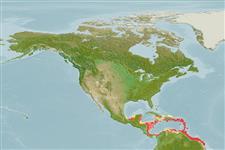
marien demersaal; diepte 27 - 165 m (Ref. 91765). Tropical; 21°N - 2°N, 97°W - 49°W (Ref. 91765)
Western Atlantic: along the northern coast of South America from Colombia to Cabo Orange, Brazil (north of the mouth of the Amazon); including Gulf of Campeche, Mexico, Nicaragua, Panama, shelf area from northern Puerto Rico to the US Virgin Islands.
Grootte / Gewicht / Leeftijd
Maturiteit: Lm ? range ? - ? cm
Max length : 27.0 cm SL mannelijk / geslacht onbekend; (Ref. 91765); common length : 18.0 cm TL mannelijk / geslacht onbekend; (Ref. 5217)
Korte beschrijving
Determinatiesleutels | Morfologie | Morfometrie
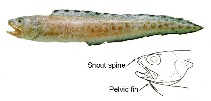
Dorsale stekels (totaal) : 0; Dorsale zachte stralen (totaal) : 127 - 130; Anale stekels: 0; Anale zachte stralen: 104 - 112; Wervels: 69 - 72. This species is characterized by the following: usual number of vertebrae, precaudal 15 (14), caudal 56-57 (54-58), total 71-72 (69-72); fin rays, dorsal 127-130 (125-133), anal 106-108 (104-112) pectoral 20-21 (22); pyloric caeca usually 3 (1-4), most often with 2 in one tier and 1 in second, when 4, they are 3+1; first gill arch with rudimentary rakers 2 on the upper arm, 4 (rarely 5) developed rakers on the lower limb, usually 2 (1-3) rudimentary rakers anteriorly on the first arch; total rakers usually 8-9; dorsal-fin origin between neural spines 2-3 (18 specimens) or 3-4 (11 specimens), in most instances is almost directly over neural spine 3 (Ref. 91765).
Body shape (shape guide): elongated; Cross section: compressed.
Common species (Ref. 34024). Found on the continental shelf, on soft bottom (Ref. 5217). Oviparous, with oval pelagic eggs floating in a gelatinous mass (Ref. 205).
Levenscyclus en paargedrag
Maturiteit | Voortplanting | Paaien | Eieren | Fecunditeit | Larven
Robins, C.R., R.H. Robins and M.E. Brown, 2012. A revision of Lepophidium (Teleoastei, Ophidiidae), with descriptions of eight new species. Bulletin of the Florida Museum of Natural History 52(1):1-94. (Ref. 91765)
Status op de Rode Lijst van het IUCN (Ref. 130435: Version 2025-2 (Global))
Gevaar voor de mens
Harmless
Gebruik door de mens
Visserij: bycatch
Tools
Speciale rapporten
Download XML
Internetbronnen
Schattingen op basis van modellen
Gewenste temperatuur (Ref.
123201): 21.7 - 27.1, mean 25.6 °C (based on 64 cells).
Fylogenetische diversiteitsindex (Ref.
82804): PD
50 = 0.5000 [Uniqueness, from 0.5 = low to 2.0 = high].
Bayesian length-weight: a=0.00240 (0.00103 - 0.00560), b=3.17 (2.99 - 3.35), in cm total length, based on LWR estimates for this Genus-body shape (Ref.
93245).
Trofisch niveau (Ref.
69278): 3.6 ±0.7 se; based on size and trophs of closest relatives
Weerstandsvermogen (Ref.
120179): Hoog, minimale populatieverdubbelingstijd minder dan 15 maanden (Preliminary K or Fecundity.).
Kwetsbaarheid van de visserij (Ref.
59153): Low vulnerability (23 of 100).
🛈