>
Osteoglossiformes (Bony tongues) >
Osteoglossidae (Arowanas)
Etymology: Scleropages: Greek, skleros = hard + Greek, page, -es = knot (Ref. 45335).
Eponymy: Francis Lascelles ‘Frank’ Jardine (1841–1919) was a pastoralist and pioneer associated with the exploration and settlement of the Cape York Peninsula in Queensland, where the Jardine River is named after him. [...] (Ref. 128868), visit book page.
More on author: Saville-Kent.
Ambiente: milieu / zona climática / intervalo de profundidade / gama de distribuição
Ecologia
; Água doce pelágico(a,os,as). Tropical; ? - 15°C (Ref. 44894); 6°S - 14°S
Asia and Oceania: northern Australia and central-southern New Guinea (Ref. 58511).
Comprimento na primeira maturidade / Tamanho / Peso / Idade
Maturidade: Lm 45.0 range ? - ? cm
Max length : 100.0 cm SL macho/indeterminado; (Ref. 44894); common length : 55.0 cm SL macho/indeterminado; (Ref. 44894)
Descrição breve
Chaves de identificação | Morfologia | Morfometria
Espinhos dorsais (total) : 0; Raios dorsais moles (total) : 20 - 24; Espinhos anais: 0; Raios anais moles: 28 - 32.
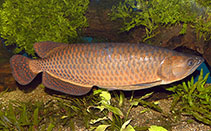
Body shape (shape guide): fusiform / normal.
Adults occur in still waters of streams and swamps where it is usually seen near the surface or close to shore among aquatic vegetation (Ref. 2847, 44894). Solitary, territorial and spawn prior to the wet season when surface water temperatures approach 30°C (Ref. 44894). Young feed primarily on microcrustaceans (Ref. 2847). Primarily a surface feeder, feeding on a variety of terrestrial and aquatic insects, small fishes, frogs, crustaceans, and some plant material (Ref. 44894). Mouthbrooders (Ref. 56180). Maximum weight reported in Ref. 5259 may be 12.27 kg (W. Lau, pers. Comm. 07/05). Important food fish (Ref. 58511) and a valuable aquarium fish (Ref. 83518).
Fertilized eggs are carried in the mouth of the female. Eggs hatch in 1-2 weeks. Larvae, with their enlarged yolk sac, are kept in or close to the mouth for another 4 or 5 weeks. Young fish commence feeding, primarily on microcrustaceans, at a size of 2-3 cm, well before the yolk sac is entirely resorbed. Become independent at a length of 3.5-4.0 cm.
Allen, G.R., 1991. Field guide to the freshwater fishes of New Guinea. Publication, no. 9. 268 p. Christensen Research Institute, Madang, Papua New Guinea. (Ref. 2847)
Categoria na Lista Vermelha da IUCN (Ref. 130435: Version 2025-2 (Global))
Ameaça para o homem
Harmless
Utilização humana
Pescarias: sem interesse; Aquacultura: espécies comerciais; peixe desportivo: sim; Aquário: Espécies comerciais
Ferramentas
Relatórios especiais
Descarregue XML
Fontes da internet
Estimativas baseadas em modelos
Índice de diversidade filogenética (Ref.
82804): PD
50 = 0.5781 [Uniqueness, from 0.5 = low to 2.0 = high].
Bayesian length-weight: a=0.01122 (0.00514 - 0.02450), b=3.04 (2.87 - 3.21), in cm total length, based on all LWR estimates for this body shape (Ref.
93245).
Nível Trófico (Ref.
69278): 2.8 ±0.1 se; based on diet studies.
Resiliência (Ref.
120179): Baixo, tempo mínimo de duplicação da população 4,5 - 14 anos (tm=4-5; Fec=30-130).
Vulnerabilidade da pesca (Ref.
59153): High to very high vulnerability (73 of 100).
🛈