Klassifizierung / Names
Namen | Synonyme | Catalog of Fishes(Gattung, Arten) | ITIS | CoL | WoRMS | Cloffa
Taxonomic Remarks
See Mees (1987: 184) for detailed description.
Umwelt: Milieu / Klimazone / Tiefenbereich / Verbreitungsgebiet
Ökologie
; süßwasser; brackwasser demersal. Tropical
Central and South America: lower portions of coastal rivers from Venezuela to northern Brazil.
Größe / Gewicht / Alter
Geschlechtsreife: Lm ? range ? - ? cm
Max length : 38.3 cm SL Männchen/unbestimmt; (Ref. 36695); common length : 35.0 cm TL Männchen/unbestimmt; (Ref. 5217)
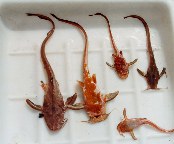
Benthic fish occurring on sandy-muddy bottoms of brackish waters (Ref. 35381) and coastal rivers (Ref. 36695). Found on soft bottoms of shallow turbid water near river mouths. The species has a peculiar mode of egg incubation wherein the female banjo catfish carries the eggs firmly attached to the underside of the body. This seems to be an adaptation to facilitate the oxygenation of the eggs in muddy environments. Reproduction probably occurs during the earlier part of the year (Ref. 35381).
Lebenszyklus und Paarungsverhalten
Geschlechtsreife | Fortpflanzung | Ablaichen | Eier | Fruchtbarkeit | Larven
Females carry their eggs and young attached to the ventral surface of the body.
Cervigón, F., R. Cipriani, W. Fischer, L. Garibaldi, M. Hendrickx, A.J. Lemus, R. Márquez, J.M. Poutiers, G. Robaina and B. Rodriguez, 1992. Fichas FAO de identificación de especies para los fines de la pesca. Guía de campo de las especies comerciales marinas y de aquas salobres de la costa septentrional de Sur América. FAO, Rome. 513 p. Preparado con el financiamento de la Comisión de Comunidades Europeas y de NORAD. (Ref. 5217)
IUCN Rote Liste Status (Ref. 130435: Version 2025-2 (Global))
Bedrohung für Menschen
Harmless
Nutzung durch Menschen
Fischereien: weniger kommerziell; Aquarium: Kommerziell
Tools
Zusatzinformationen
Download XML
Internet Quellen
Schätzungen auf der Grundlage von Modellen
Phylogenetischer Diversitätsindex (Ref.
82804): PD
50 = 1.0000 [Uniqueness, from 0.5 = low to 2.0 = high].
Bayesian length-weight: a=0.00204 (0.00098 - 0.00424), b=3.00 (2.82 - 3.18), in cm total length, based on LWR estimates for this species & (Sub)family-body (Ref.
93245).
Trophische Ebene (Ref.
69278): 3.3 ±0.4 se; based on size and trophs of closest relatives
Generation time: 3.9 ( na - na) years. Estimated as median ln(3)/K based on 1
growth studies.
Widerstandsfähigkeit (Ref.
120179): mittel, Verdopplung der Population dauert 1,4 - 4,4 Jahre. (K=0.28).
Anfälligkeit der Fischerei (Ref.
59153): Moderate vulnerability (37 of 100).
🛈