>
Petromyzontiformes (Lampreys) >
Mordaciidae (Southern topeyed lampreys)
Etymology: Mordacia: Etymology not explained, likely derived from mordax (L.), biting, referring to specific name of M. mordax (See ETYFish); mordax: Latin for biting, perhaps referring to its parasitic behavior and/or serrated, cutting teeth (See ETYFish).
More on author: Richardson.
สิ่งแวดล้อม : สิ่งแวดล้อม / เขตภูมิอากาศ / ระดับความลึก / ระยะการกระจายสินค้า
นิเวศวิทยา
เกี่ยวกับทะเล,น้ำเค็ม; น้ำจืด; กร่อย สัตว์น้ำหน้าดิน; ปลาที่อพยพจากแหล่งน้ำเค็มไปวางไข่ในแหล่งน้ำจืด (Ref. 89241). Temperate; 35°S - 44°S (Ref. 26213)
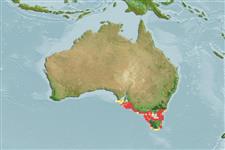
Southern Ocean: Southeastern Australia from Shoalhaven River, New South Wales to Gulf of St. Vincent, South Australia.
ขนาด / น้ำหนัก / อายุ
วัยเจริญพันธุ์: Lm ? range ? - ? cm
Max length : 50.0 cm TL เพศผู้/กระเทย; (Ref. 5259); common length : 37.5 cm TL เพศผู้/กระเทย; (Ref. 5259)
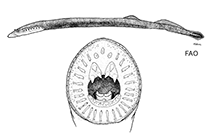
Adults: 11.3-43.2 cm TL; body proportions of pre-spawning specimens, as percentage of TL (based on 125 prespawning specimens measuring 11.3-42.1 cm TL): 8.5-11.3 prebranchial length, 7.1-9.8 branchial length, 60.4-68.3 trunk length, 14.4-20.1 tail length, 1.1-1.7 eye length and 4.9-6.6 disc length. Body proportions of spawning male specimens, as percentage of TL (based on 8 spawning males measuring 27.7-37.6 cm TL): 11.4-16.6 prebranchial length, 8.8-10.1 branchial length, 60.1-65.3 trunk length, 13.3-15.7 tail length, 8.1-11.2 disc length. Mature males with some loose skin in gular region. Urogenital papilla not prominent in mature adults; trunk myomeres, 84-96. Adult dentition: 2 triangular supraoral laminae each with 3 unicuspid teeth, 1 per apex; infraoral lamina, 7-9 unicuspid teeth of various size (these teeth become greatly enlarged with sexual maturation); 5-7 endolateral plates on either side each bearing 2-3 unicuspid teeth, usually 3; endolateral formula, typically 2-3-3-3-3-3 in immature individuals and 5-7 individual cusps on either side in mature individuals; 1 row of anterials; first row of anterials, 2 unicuspid teeth plus 1-2 bicuspid teeth or 3 unicuspid teeth flanked on either side by 1 bicuspid tooth; 1 row of exolaterals on each side; 1 row of posterials; first row of posterials, 12-14 posterial plates, the 2-4 lateralmost tricuspid and the internal ones bicuspid in immature individuals and 12-14 unicuspid teeth in mature individuals; transverse lingual lamina w-shaped, with 29 unicuspid teeth, the median one and the 2 subterminal ones slightly enlarged; longitudinal lingual laminae interrupted j-shaped, each with an undetermined number of unicuspid teeth. Velar tentacles in adults, 3-4, smooth. Body coloration (live) of immature adults brownish gray on dorsal surface and silvery on ventral surface; lateral line neuromasts darkly pigmented; caudal fin pigmentation, 25% to <75% coverage; caudal fin shape, spade-like; oral papillae, 25-45 (Ref. 89241).
Body shape (shape guide): eel-like.
Adults inhabit the sea for an undetermined period and are parasitic on fishes; enter freshwater to breed. Majority of adulthood is spent in estuaries or at sea. Upstream spawning migrants occur in fast-flowing sections of rivers with a mud, sand or silt substrate, sometimes seen congregated below barriers to upstream movement such as weirs. Ammocoetes live in slow-flowing streams, burrowed in mud or silt. Common length is 35-40 cm (Ref. 44894). Larval life is 3.5 yrs. During the spawning migration, adults burrow in the substrate of rivers during the day and migrate upstream during the night. Fecundity, 3,789-13,372 eggs/female. De Castelnau (1872) states that the adults from the lower Yarra River, Victoria, are considered good food (Ref. 89241).
Allen, G.R., 1989. Freshwater fishes of Australia. T.F.H. Publications, Inc., Neptune City, New Jersey. (Ref. 5259)
สถานะบัญชีแดงของ IUCN (Ref. 130435: Version 2025-2 (Global))
ภัยคุกคามต่อมนุษย์
Harmless
การใช้ของมนุษย์
เครื่องมือ
รายงานพิเศษ
ดาวน์โหลด XML
แหล่งที่มาจากอินเตอร์เน็ต
การประมาณค่าตามแบบจำลอง
อุณหภูมิที่ต้องการ (อ้างอิง
123201): 14.3 - 16.8, mean 15.4 °C (based on 44 cells).
ดัชนีความหลากหลายทางวิวัฒนาการ (อ้างอิง
82804): PD
50 = 0.7500 [Uniqueness, from 0.5 = low to 2.0 = high].
Bayesian length-weight: a=0.00102 (0.00046 - 0.00225), b=3.06 (2.88 - 3.24), in cm total length, based on all LWR estimates for this body shape (Ref.
93245).
ระดับชั้นอาหาร (อ้างอิง
69278): 4.3 ±0.8 se; based on size and trophs of closest relatives
ความสามารถในการกลับคืนสู่ปกติ (อ้างอิง
120179): ต่ำ, เวลาต่ำสุดที่จะทำให้ประชากรเพิ่มขึ้นเป็น 2 เท่าใช้เวลา 4.5 - 14 ปี (Semelparous species, assuming tm (= tmax) > 4).
ความเสี่ยงต่อการตกปลา (Ref.
59153): Moderate vulnerability (40 of 100).
🛈