Elasmobranchii (Haie und Rochen) (sharks and rays) >
Lamniformes (Mackerel sharks) >
Odontaspididae (Sand tiger sharks)
Etymology: Odontaspis: Etymology not explained, presumably odontos (Gr.), tooth, and aspis (Gr.), shield, perhaps referring to how teeth comprise a prominent narrow cusp provided with two or more small “side teeth” (translation), i.e., cusplets, which, with some imagination, could be said to “shield” the main cusp; another explanation: aspis (L.), viper, perhaps referring to outwardly pointing teeth of O. ferox, like that of a viper (See ETYFish); noronhai: In honor of Adolfo César de Noronha (1873-1963), late director of the Funchal Museum (Madeira), where holotype is housed (See ETYFish).
Eponymy: Adolfo César de Noronha (1873–1963) was a naturalist and librarian who was Director of the Funchal Museum in Madeira (where the type specimen of the shark is housed). [...] (Ref. 128868), visit book page.
Umwelt: Milieu / Klimazone / Tiefenbereich / Verbreitungsgebiet
Ökologie
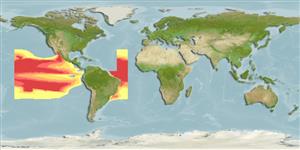
seewasser pelagic-oceanic; tiefenbereich 60 - 1000 m (Ref. 10722). Deep-water; 31°N - 34°S, 163°W - 27°W (Ref. 54682)
Eastern Atlantic: Madeira and southern Brazil. Eastern Central Pacific: off Hawaii. May eventually be recorded from the Western Central Pacific (Ref. 13568). Questionably occurring in Seychelles.
Länge bei der ersten Reifung / Größe / Gewicht / Alter
Geschlechtsreife: Lm 325.0 range ? - ? cm
Max length : 367 cm TL Männchen/unbestimmt; (Ref. 247); 326.0 cm TL (female)
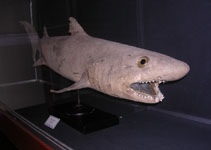
Snout conical and bulbous, tip rounded. Eyes large and ovoid, nictitating membrane absent. Body color uniform chocolate brown, all fins except pectorals with thin dark edging along posterior margin.
Body shape (shape guide): fusiform / normal.
A deepwater shark inhabiting the continental and insular slopes (Ref. 50449, 58302). Pelagic (Ref. 58302). Ovoviviparous, embryos feeding on yolk sac and other ova produced by the mother (Ref. 50449). Feeding habits unknown.
Lebenszyklus und Paarungsverhalten
Geschlechtsreife | Fortpflanzung | Ablaichen | Eier | Fruchtbarkeit | Larven
Exhibit ovoviparity (aplacental viviparity), with embryos feeding on other ova produced by the mother (oophagy) after the yolk sac is absorbed (Ref. 50449). Distinct pairing with embrace (Ref. 205).
Compagno, L.J.V., 1984. FAO Species Catalogue. Vol. 4. Sharks of the world. An annotated and illustrated catalogue of shark species known to date. Part 1 - Hexanchiformes to Lamniformes. FAO Fish. Synop. 125(4/1):1-249. Rome, FAO. (Ref. 247)
IUCN Rote Liste Status (Ref. 130435: Version 2025-2 (Global))
Bedrohung für Menschen
Harmless
Nutzung durch Menschen
Fischereien: kommerzielles potential
Tools
Zusatzinformationen
Download XML
Internet Quellen
Schätzungen auf der Grundlage von Modellen
Bevorzugte Temperatur (Ref.
123201): 8.6 - 15.2, mean 12 °C (based on 13 cells).
Phylogenetischer Diversitätsindex (Ref.
82804): PD
50 = 1.0000 [Uniqueness, from 0.5 = low to 2.0 = high].
Bayesian length-weight: a=0.01122 (0.00514 - 0.02450), b=3.04 (2.87 - 3.21), in cm total length, based on all LWR estimates for this body shape (Ref.
93245).
Trophische Ebene (Ref.
69278): 4.4 ±0.4 se; based on size and trophs of closest relatives
Widerstandsfähigkeit (Ref.
120179): sehr niedrig, Verdopplung der Population dauert mehr als 14 Jahre. (Fec assumed to be <10).
Anfälligkeit der Fischerei (Ref.
59153): Very high vulnerability (90 of 100).
🛈