Élasmobranches (requins et raies) (sharks and rays) >
Lamniformes (Mackerel sharks) >
Odontaspididae (Sand tiger sharks)
Etymology: Odontaspis: Etymology not explained, presumably odontos (Gr.), tooth, and aspis (Gr.), shield, perhaps referring to how teeth comprise a prominent narrow cusp provided with two or more small “side teeth” (translation), i.e., cusplets, which, with some imagination, could be said to “shield” the main cusp; another explanation: aspis (L.), viper, perhaps referring to outwardly pointing teeth of O. ferox, like that of a viper (See ETYFish); ferox: Latin for fierce, possibly referring to what Risso described as its “La voracité extrême” and/or its toothy and ferocious countenance (See ETYFish).
More on author: Risso.
Environnement : milieu / zone climatique / profondeur / gamme de distribution
Écologie
marin benthopélagique; profondeur 10 - 2000 m (Ref. 26346), usually 13 - 880 m (Ref. 89422). Deep-water; 50°N - 49°S, 180°W - 180°E (Ref. 54681)
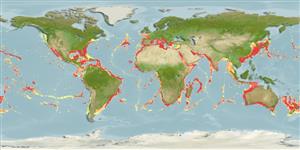
Eastern Atlantic: Gulf of Gascony, Madeira, Morocco, Mediterranean; also Cape Verde (Ref. 27000). Western Atlantic: Yucatan Shelf, Mexico (Ref. 9939), Brazil (Ref. 53443). Indo-West Pacific: off South Africa and Maldives, Madagascar, southern Japan, Australia, and New Zealand (Ref. 13568). Expected to occur in the Western Central Pacific (Ref. 13568). Central Pacific: off Hawaii (Ref. 13568). Eastern Pacific: off southern California, USA and Baja California, Mexico (Ref. 13568).
Longueur à la première maturité / Taille / Poids / Âge
Maturité: Lm ? range ? - 360 cm
Max length : 450 cm TL mâle / non sexé; (Ref. 89422); poids max. publié: 289.0 kg (Ref. 9939)
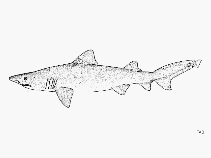
Épines dorsales (Total) : 0; Épines anales: 0. A shark with a short, pointed snout, small eyes, protruding spike-like teeth, and small, equal-sized dorsal and anal fins; first dorsal closer to pectoral than to pelvic fins (Ref. 5578). Grey above, paler below (Ref. 6586); may have red spots on sides (Ref. 5578).
Body shape (shape guide): fusiform / normal.
Found on or near the bottom of the continental and insular shelves and upper slopes (Ref. 6871); sometimes in shallow water (Ref. 6871). Tagging showed the species dives up to 2,000 m at Malpelo Island, Colombia (S.Bessudo, pers.comm. 06/09). Feeds on small bony fishes, squids, and crustaceans (Ref. 13568). Uses its long body cavity and large, oily liver to regulate buoyancy. Ovoviviparous, embryos feeding on yolk sac and other ova produced by the mother (Ref. 50449). Not implicated in attacks on people (Ref. 247). Flesh utilized for human consumption and liver for its high squalene content (Ref. 247); utilization of fins, jaws and cartilage (Ref.58048).
Cycle de vie et comportement reproducteur
Maturité | Reproduction | Frai | Œufs | Fécondité | Larves
Exhibit ovoviparity (aplacental viviparity), with embryos feeding on other ova produced by the mother (oophagy) after the yolk sac is absorbed (Ref. 50449). Two young born at 105 cm or larger (Ref. 26346). Distinct pairing with embrace (Ref. 205).
Compagno, L.J.V., 1984. FAO Species Catalogue. Vol. 4. Sharks of the world. An annotated and illustrated catalogue of shark species known to date. Part 1 - Hexanchiformes to Lamniformes. FAO Fish. Synop. 125(4/1):1-249. Rome, FAO. (Ref. 247)
Statut dans la liste rouge de l'IUCN (Ref. 130435: Version 2025-2 (Global))
Utilisations par l'homme
Pêcheries: commercial
Outils
Articles particuliers
Télécharger en XML
Sources Internet
Estimations basées sur des modèles
Température préférée (Réf.
123201): 12.2 - 23.9, mean 17.3 °C (based on 810 cells).
Indice de diversité phylogénétique (Réf.
82804): PD
50 = 1.0000 [Uniqueness, from 0.5 = low to 2.0 = high].
Bayesian length-weight: a=0.01122 (0.00514 - 0.02450), b=3.04 (2.87 - 3.21), in cm total length, based on all LWR estimates for this body shape (Ref.
93245).
Niveau trophique (Réf.
69278): 4.2 ±0.56 se; based on food items.
Résilience (Réf.
120179): Très faible, temps minimum de doublement de population supérieur à 14 ans (Fec assumed to be <10).
Vulnérabilité de la pêche (Ref.
59153): Very high vulnerability (90 of 100).
🛈
Nutriments (Ref.
124155): Calcium = 2.12 [0.49, 12.27] mg/100g; Iron = 0.217 [0.051, 0.701] mg/100g; Protein = 18.4 [16.0, 20.8] %; Omega3 = 0.34 [0.14, 0.81] g/100g; Selenium = 26.9 [7.0, 81.4] μg/100g; VitaminA = 6.46 [1.47, 28.36] μg/100g; Zinc = 0.187 [0.092, 0.357] mg/100g (wet weight);