>
Beloniformes (Needle fishes) >
Exocoetidae (Flyingfishes)
Etymology: Hirundichthys: latin, hirundo = swift; 1300 + Greek, ichthys = fish (Ref. 45335).
More on author: Günther.
Environnement : milieu / zone climatique / profondeur / gamme de distribution
Écologie
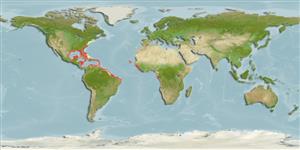
marin pelagic-neritic; océanodrome (Ref. 51243); profondeur 0 - 100 m (Ref. 5217). Subtropical; 41°N - 13°S, 98°W - 14°E
Eastern Atlantic: Guinea to Angola. Western Atlantic: Gulf Stream off Virginia, USA and northern Gulf of Mexico to northern Brazil (Ref. 7251), including the Caribbean Sea (Ref. 3720). Northwest Atlantic: Canada (Ref. 5951).
Longueur à la première maturité / Taille / Poids / Âge
Maturité: Lm 25.1 range ? - ? cm
Max length : 33.0 cm TL mâle / non sexé; (Ref. 109257); common length : 24.0 cm TL mâle / non sexé; (Ref. 5217); âge max. reporté: 1.00 années (Ref. 6503)
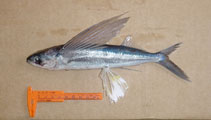
Épines dorsales (Total) : 0; Rayons mous dorsaux (Total) : 11; Épines anales: 0; Rayons mous anaux: 11 - 12. Body elongate, thick, somewhat flattened ventrally; snout shorter than eye, blunt; palatine teeth usually absent; dorsal and anal fins set far back on body, their bases short; dorsal fin low, rays at anterior end the longest; anal fin origin slightly before, or 1 or 2 rays behind dorsal fin origin; pectoral fins strikingly long, 60 to 70 % of SL, only first ray unbranched; pelvic fins large, reaching well beyond anal fin origin; more than 25 scale rows of predorsal scales; dorsally, the color is usually iridescent blue or green in life; dorsal fin colorless or only slightly pigmented; pectoral fins dark, with a pale basal triangle and a narrow white margin (on trailing edge when extended) (Ref. 3720).
Body shape (shape guide): elongated; Cross section: other (see diagnosi.
Occurs in surface waters both near and far from the coast (Ref. 5217). Forms schools. Capable of leaping out and gliding for long distances above the water. Seasonal variation in abundance was noted in the eastern Caribbean countries, a phenomenon that may be due to post-spawning mortality (Ref. 6838). The most important commercial fish species of the eastern Caribbean (Ref. 6504). Considered a good food fish; marketed fresh.
Cycle de vie et comportement reproducteur
Maturité | Reproduction | Frai | Œufs | Fécondité | Larves
Spawns on the water surface and to a depth of 20 m (Ref. 6834). Post-spawning mortality may explain the disappearance of mature cohorts at the close of the spawning season in June (Ref. 6838).
Gibbs, R.H. Jr., 1978. Exocoetidae. In W. Fischer (ed.) FAO species identification sheets for fishery purposes. Western Central Atlantic (Fishing Area 31). Vol. 2. pag.var. (Ref. 3720)
Statut dans la liste rouge de l'IUCN (Ref. 130435: Version 2025-2 (Global))
Menace pour l'homme
Harmless
Utilisations par l'homme
Pêcheries: commercial; appât: usually
Outils
Articles particuliers
Télécharger en XML
Sources Internet
Estimations basées sur des modèles
Température préférée (Réf.
123201): 14.3 - 23.6, mean 20 °C (based on 39 cells).
Indice de diversité phylogénétique (Réf.
82804): PD
50 = 0.5002 [Uniqueness, from 0.5 = low to 2.0 = high].
Bayesian length-weight: a=0.00813 (0.00422 - 0.01564), b=3.01 (2.83 - 3.19), in cm total length, based on LWR estimates for this species & (Sub)family-body (Ref.
93245).
Niveau trophique (Réf.
69278): 3.8 ±0.56 se; based on food items.
Generation time: 0.6 ( na - na) years. Estimated as median ln(3)/K based on 1
growth studies.
Résilience (Réf.
120179): Haut, temps minimum de doublement de population inférieur à 15 mois (tm<1; tmax=1).
Vulnérabilité de la pêche (Ref.
59153): Low vulnerability (16 of 100).
🛈
Nutriments (Ref.
124155): Calcium = 396 [116, 1,186] mg/100g; Iron = 3.76 [1.31, 9.56] mg/100g; Protein = 17.8 [15.4, 20.2] %; Omega3 = 0.379 [0.103, 1.550] g/100g; Selenium = 69.1 [18.9, 235.1] μg/100g; VitaminA = 3.98 [0.62, 29.25] μg/100g; Zinc = 1.31 [0.68, 2.45] mg/100g (wet weight);