Classificazione / Nomi
Nomi Comuni | Sinonimi | Catalog of Fishes(Genere, Specie) | ITIS | CoL | WoRMS | Cloffa
Taxonomic Remarks
Ref. 2334 explains the use of current genus name.
Ambiente: milieu / zona climatica / distribuzione batimetrica / gamma di distribuzione
Ecologia
marino associati a barriera corallina; distribuzione batimetrica 0 - 18 m (Ref. 30874), usually 1 - 15 m (Ref. 27115). Tropical; 22°C - 28°C (Ref. 27115); 36°N - 29°S, 91°E - 155°W
Pacific Ocean: Christmas Island in the eastern Indian Ocean to the Line Islands, north to the Yaeyama Islands, south to the Great Barrier Reef, Fiji and Samoa. Replaced by Pseudanthias ignitus in the Indian Ocean (Ref. 37816).
Dimensione / Peso / Età
Maturità: Lm ? range ? - ? cm
Max length : 9.5 cm TL maschio/sesso non determinato; (Ref. 2334)
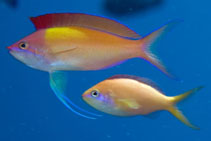
Spine dorsali (totale) : 10; Raggi dorsali molli (totale) : 16 - 18; Spine anali: 3; Raggi anali molli: 7 - 8. Male displays a bright red dorsal fin. Ventral fins greatly extended. Female orange with yellowish tail and a pink line from the tip of the snout angling down, passing through the lower part of the eye (Ref. 48635).
Body shape (shape guide): fusiform / normal.
Found at the upper-edge of steep outer reef slopes (Ref. 9710), with moderate currents (Ref. 48635). Occurs in large aggregations (Ref. 37816), of mixed sexes when feeding in currents sweeping the reef (Ref. 48635). Minimum depth reported taken from Ref. 128797.
Ciclo vitale e comportamento di accoppiamento
Maturità | Riproduzione | Deposizione | Uova | Fecondità | Larve
Gill, A.C., 2022. Revised definitions of the anthiadine fish genera Mirolabrichthys Herre and Nemanthias Smith, with description of a new genus (Teleostei: Serranidae). Zootaxa 5092(1):041-066. (Ref. 127988)
Stato della Lista Rossa IUCN (Ref. 130435: Version 2025-2 (Global))
Minaccia per l'uomo
Harmless
Usi umani
Pesca: commerciale; Acquario: Commerciale
Strumenti
Rapporti speciali
Scarica XML
Fonti Internet
Stime basate su modelli
Temperatura preferita (Fonte Biblio.
123201): 24.7 - 28.5, mean 27.4 °C (based on 923 cells).
Indice di diversità filogenetica (Fonte Biblio.
82804): PD
50 = 0.5312 [Uniqueness, from 0.5 = low to 2.0 = high].
Bayesian length-weight: a=0.01288 (0.00685 - 0.02423), b=3.02 (2.85 - 3.19), in cm total length, based on LWR estimates for this species & (Sub)family-body (Ref.
93245).
Livello trofico (Fonte Biblio.
69278): 3.3 ±0.4 se; based on size and trophs of closest relatives
Resilienza (Fonte Biblio.
120179): Alto, tempo minimo di raddoppiamento della popolazione meno di 15 mesi (Preliminary K or Fecundity.).
Vulnerabilità della pesca (Ref.
59153): Low vulnerability (10 of 100).
🛈
Nutrienti (Ref.
124155): Calcium = 130 [69, 276] mg/100g; Iron = 0.982 [0.526, 1.773] mg/100g; Protein = 18 [16, 20] %; Omega3 = 0.157 [0.090, 0.272] g/100g; Selenium = 21.8 [11.7, 44.4] μg/100g; VitaminA = 217 [70, 722] μg/100g; Zinc = 1.91 [1.24, 2.86] mg/100g (wet weight);